



Build behavior deliberately without making confusion do the teaching.
This course is part of the education path
Buy 20% cheaper the bundle Get the best deal!
See Education PathSTARTS November 1, 2026 · AUDITOR US$139 · PREMIUM US$299 · 10 PREMIUM PLACES
Your learner should not have to guess what earns reinforcement. Neither should you.
Learn to observe, plan, build, and troubleshoot behavior without making endless trial and error—or the learner’s frustration—do the teaching for you.
Shape Me Up! treats shaping as a complete system: the goal behavior, prerequisite skills, antecedent arrangement, criteria, reinforcement placement, the return for the next repetition, and the evidence that tells you what to change.
- Starts:
- 1 November 2026
- Format:
- six-week online course
- Access:
- one year from purchase
A shaping session is a connected sequence
Define the behavior
What would a camera record?
↓
Find the building blocks
Which movement or prerequisite is missing?
↓
Choose one criterion
Which observable change earns reinforcement now?
↓
Plan delivery and return
What will make the next useful repetition likely?
Then look at what the learner actually did. A beautiful plan is still a hypothesis.
Design the learning process
- See before you click
- Describe the behavior in observable detail and notice the first useful movement.
- Build from modules
- Teach component skills separately, strengthen them, and assemble them deliberately.
- Plan the next repetition
- Use reinforcement placement and the return to support what should happen next.
What exactly is the learner supposed to “figure out”?
You begin a shaping session with a clicker, food, and a behavior in mind. You click one small movement. The dog offers something else. Then a sit, a paw, a spin, a bark, or another behavior that has produced reinforcement before. You keep watching for something closer to the goal while the learner keeps searching through their reinforcement history.
This is often described as creativity. Sometimes it is useful variability. Sometimes it is a learner working inside a problem that has not been made clear enough.
“Let the dog figure it out” sounds empowering until we ask what information the training arrangement has actually supplied. If the plan is to stop reinforcing what worked a moment ago and wait for something better, extinction can begin doing much of the teaching. The session may fill with hesitation, repeated old behavior, changes in pace, vocalization, disengagement, or frantic experimentation.
The learner is not the problem. The design is where we look first.
Errorless does not mean perfect
Errors will happen. Error-minimizing shaping does not require a flawless learner or a laboratory vacuum. It means errors are treated as information, not as the engine of learning.
Instead of repeating the same arrangement and hoping the learner eventually finds the answer, you learn to examine the conditions around the behavior:
- Is the criterion observable, achievable, and relevant to the final behavior?
- Does the learner have the movement, balance, or orientation skill this step requires?
- Is the environment cueing a different response?
- Is reinforcement placement supporting the next repetition—or disrupting it?
- Did handler movement, an object, a food position, or an old cue alter the behavior?
- Is the learner readily returning, and is this actually the moment to raise criteria?
The aim is not to remove every challenge. It is to make successful approximations accessible, consequences understandable, and unnecessary frustration less likely.
The training begins before the click
The marker matters, but shaping starts with observation and design. What does the terminal behavior look like? Which details are essential? Which prerequisite is missing? What can the environment make easier? Where will reinforcement happen, and what will that placement set up next?
- Describe the terminal behavior. Replace a vague goal with actions a camera could record.
- Identify the modules. Find the movements, positions, orientations, objects, and environmental conditions the behavior requires.
- Arrange the first useful movement. Use the environment, targets, delivery patterns, luring, or other prompts thoughtfully rather than waiting for luck.
- Choose one clear criterion. Make it positive, observable, concise, focused on one thing, and doable now.
- Plan reinforcement and return. Decide where reinforcement happens and how the learner can enter the next repetition.
- Read the result and revise. Change the plan when behavior shows a missing skill, conflicting cue, or criteria problem.
Welcome to LEGOLAND
Traditional shaping is often drawn as a staircase: reinforce step one, then step two, then step three. Real learning rarely behaves so politely.
Shape Me Up! uses a modular approach. A heel setup, for example, may require pivoting, backing, balance, a tuck sit, head position, and fluent standing in heel. Each block can be taught, strengthened, and then assembled.
When the behavior changes, you are no longer limited to “lower criteria and try again.” You can ask which block the structure still needs. The dog is allowed to ruin a beautiful staircase diagram. Frankly, they are very good at it.
MovementBalanceOrientationBase positionFluent behavior assembled from strong components
Leave with a system you can use again
- Create the first movement
- Turn a final goal into teachable components and arrange an accessible starting point.
- Build a repeatable loop
- Coordinate criteria, reinforcement placement, transport, and the learner’s return.
- Troubleshoot from evidence
- Use errors, latency, pace, orientation, and fluency to choose the next plan.
The course uses dog-training examples, but the analysis applies across species, behaviors, and settings. The goal is not a library of fixed recipes. It is the ability to design the next one yourself.
Your six-week learning map
Week 1 · Understand the learning process
Examine shaping, successive approximations, extinction, frustration, resurgence, capturing, luring, and the observation skills that everything else depends on.
Week 2 · See behavior and find its modules
Extract essential features from the goal, identify component skills and movement patterns, and arrange the first useful response.
Week 3 · Turn analysis into a plan
Use backchaining, transport, criteria design, and the shaping spreadsheet to move from “I know what I want” to “I know what I will reinforce.”
Week 4 · Make errors useful
Analyse missing prerequisites, conflicting cues, handler position, reinforcement effects, resets, and weak points in the behavior chain.
Week 5 · Raise criteria and add duration
Read fluency and stability, change one variable at a time, and separate duration from distance and repetition.
Week 6 · Build stimulus control
Connect fluent behavior with clear antecedents and cues while protecting learner agency and the behavior you have built.
What is included
- Six weeks of structured written lessons and video tutorials
- Real training footage with detailed shaping breakdowns
- Practical observation, planning, and training assignments
- Flowcharts and a shaping spreadsheet for session design
- Exercises in modular shaping, criteria, backchaining, delivery, duration, and stimulus control
- Access to the Tromplo learning platform and community
- Certificate of attendance upon completion
- 24/7 access to the full course for one year from purchase
What previous students noticed
“The most important things I learned are how to describe the behavior I want to teach, analyze it and divide it into small pieces.”
— Arianna Tomassoli
“After six weeks I can still use the materials for our further work for many months.”
— Janina Gmiter
“The graphics helped me a lot to get a mental picture of what I’m learning about shaping.”
— Babak Homayouni
Choose this course if shaping is the problem you want to solve
A useful fit
- The learner cycles through familiar behavior while you wait.
- You know the final goal but not how to evoke the first movement.
- The behavior changes when you raise criteria, add duration, or introduce a cue.
- The same error returns even after you temporarily make the task easier.
- You want precision while keeping agency and choice visible in the plan.
Choose by the actual bottleneck
If reliable behavior changes specifically when time increases, examine Duration by Design. If you want to use behavior-analysis concepts more precisely, examine Behavior Geek. If reinforcement placement and delivery are the main question, examine Strategic Reinforcement Delivery.
A larger course is not automatically the better decision. Choose the course that matches the behavior you can observe now.
Your instructor
Agnieszka Janarek is the founder of Tromplo and an animal trainer with a background in Applied Behavior Analysis. Her teaching begins with observable behavior, carefully arranged environments, reinforcement history, and the practical question that keeps good plans honest: what did the learner do next?
Shape Me Up! is built for intellectually curious trainers who want scientific precision without turning a training session into a vocabulary recital. A glossary is useful. It still cannot place the food for you.
Study the complete Shape Me Up! system
Auditor/self-study · US$139
Work through the complete written course, video demonstrations, practical assignments, flowcharts, and planning tools independently.
- Starts 1 November 2026
- Six-week learning path
- One year of access from purchase
- Certificate of attendance upon completion
Premium · US$299
Study the complete course and receive individual feedback on your practical work during the six-week edition.
- Starts 1 November 2026
- 10 Premium places in this edition
- Complete course materials and practical assignments
- One year of access from purchase
Choose the study format that fits the support you want for this course.
Questions before you begin
Is this a live course?
The November edition offers Auditor independent study or Premium participation with individual feedback. The material is organized across six weekly modules, and you can study and train at times that fit your schedule.
What does Auditor/self-study mean?
You receive the complete lessons, demonstrations, assignments, flowcharts, planning tools, learning-platform access, and community access. You work through the material independently.
Do I need advanced shaping experience?
No. Beginners receive a structured progression; experienced trainers gain a deeper system for analysis, criteria design, modular teaching, and troubleshooting. Curiosity and a willingness to examine your own plan matter more than an impressive trick list.
Will the course teach one specific behavior?
You will see many practical examples, but the goal is larger: learning how to design a plan for different behaviors by observing, identifying modules, choosing criteria, arranging the environment, and analysing the result.
Does errorless shaping mean the learner never makes a mistake?
No. Errors still happen. The difference is that repeated failure or confusion is not treated as the teaching method. An error becomes information about the plan, environment, criterion, cue, or a missing prerequisite.
When does the November edition begin?
Both November editions begin on 1 November 2026. You keep 24/7 access to the material for one year from the date of purchase.
Build the next repetition on purpose.
Stop waiting for a lucky approximation. Learn to observe the behavior, find its modules, arrange the conditions, and use the learner’s response to decide what the plan needs next.
Course Testimonials
Set aside the in detail words of this course, the graphics helped me a lot to get a mental picture of what I’m learning about shaping. definitely so much effort have been put behind this course which i really appreciate. thanks for making us better dog trainers. my dogs are also enjoying this knowledge that I’ve acquired and they want to say : Woof Woof !!!
August 5, 2025
Set aside the in detail words of this course, the graphics helped me a lot to get a mental picture of what I’m learning about shaping. definitely so much effort have been put behind this course which i really appreciate. thanks for making us better dog trainers. my dogs are also enjoying this knowledge that I’ve acquired and they want to say : Woof Woof !!!
August 5, 2025
I think it is so important to always try to become a better trainer and by taking an online course I both get an incentive to train – which is of course one prerequisite to improvement – but I also watch myself on video and can review what happened and even more crucial, I get feedback from a skilled trainer, who sees things from a different perspective than I do.
In this course specifically it is Agnieszka who provides the feedback and she has the perfect blend of pushing us further, sometimes setting us on a slightly different path or just cheering us on when we’re progressing. She is very creative in her solutions to any problems that arise and the feedback is so precise.
The content of the course gave me new insights in errorless and loopy training and I feel more confident moving on from this, though we didn’t reach my intended goal. But after all, it isn’t a competition, we are all on our own paths as teams with our dogs and the joy really is in the journey together, not necessarily the speed!
January 22, 2024
In this course not only I understood how deep is the ocean of shaping, but Agnieszka also did great work in dividing it into small “chewable pieces” always perfectly described and explained in lectures.
The course as always was individualized- adjusted to the level of participants and their needs. We were working on our chosen behaviours but there were always many inspirations of behaviours to learn from Agnieszka’s lectures. The form of course allows also to see other participants, which is very valuable. I love that there is lots of knowledge but always presented in a practical way both due to Agnieszka’s videos and various practical homework. The content is packed, but after 6 weeks I can still use materials for our further work for many months. I recommend it for all dog handlers who want to teach their dogs more consciously and comfortably.
January 11, 2024
This course is really important for me. I thought I was doing many things correctly but I discovered I wasn’t. The most important things I learned are how to describe the behavior I want to teach (we never do this. How can we teach a behavior if we don’t have in mind how it looks like? How can our dog learn it?), analyze it and divide it into small pieces. And this is really the key to shape behaviors. I really learned how to set my dog up to success. Agnieszka is an amazing teacher, her lessons are clear and so useful. I highly recommend this course even if you think you are a great trainer!
June 30, 2023
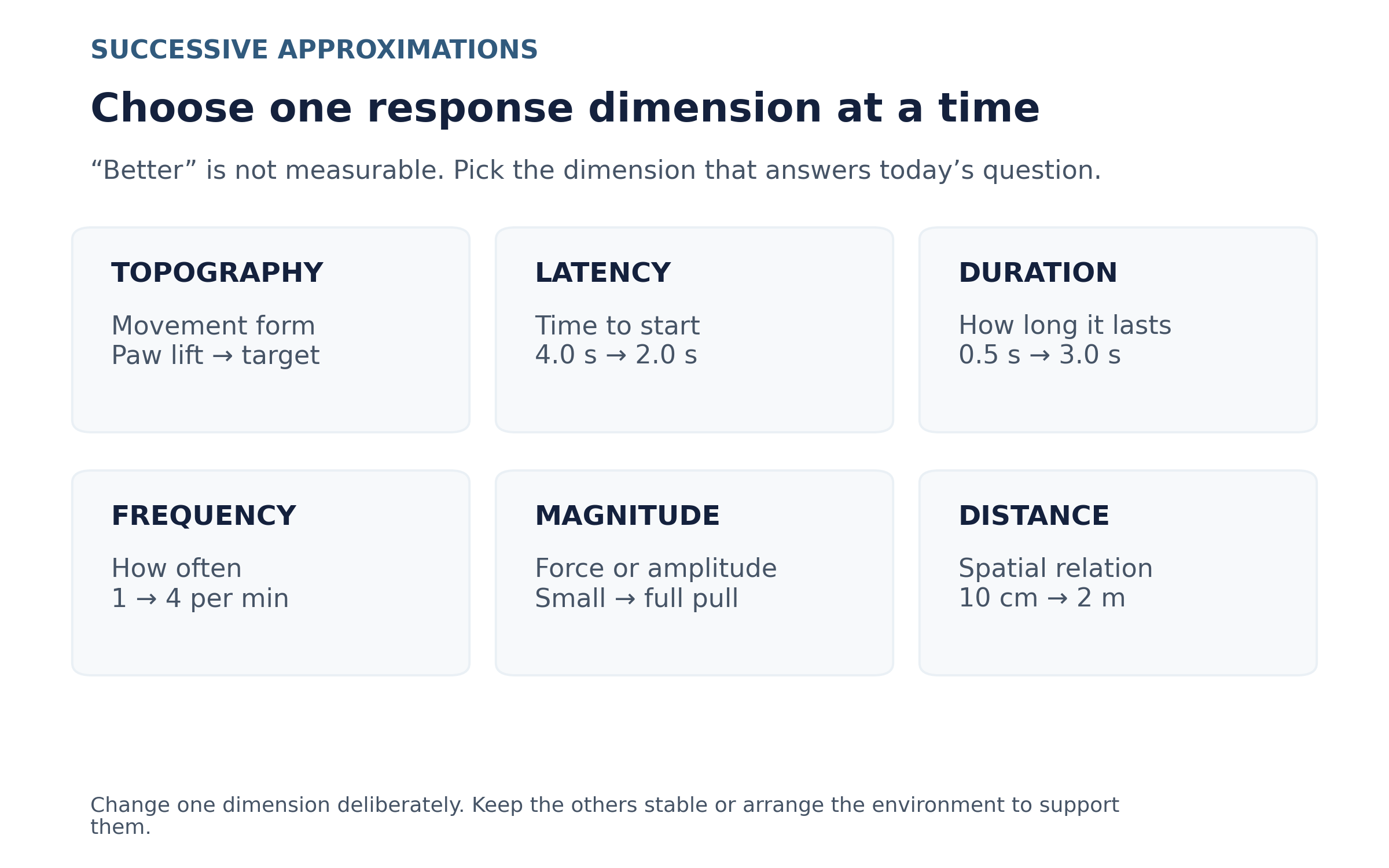 Choose one observable response dimension at a time instead of asking for a vague improvement.