
Total: $0.00
Order Go to Cart
Log In

Nosework Stage 2

Turn a trained indication into a clearer search chain

Agnieszka Janarek Agnieszka Janarek
Plan accessible single-hide searches, read change of behavior, and separate scent-physics, learner, handler, and setup questions.
Start: 01 Aug 2026
Next: TBA

Auditor:

  • Duration: 6 weeks.
  • Learning materials: Written lessons with video tutorials.
  • Access to other Premium members' threads for additional insights.
  • Certificate of attendance upon completion.
  • Lifetime, 24/7 access to course materials.
  • Join the vibrant Tromplo community.
  • Earn 4 loyalty program points.

Premium:

  • Earn 15 loyalty program points.
  • Personalized attention: Instructor analyzes 12 minutes of your training videos weekly.
  • Engage in interactive learning with homework and daily feedback.
$139.00 Add to Cart
Build independence from start line to source while making hide placement, aging, airflow, handler movement, and reinforcement deliberate.

This course is part of the education path

Performance & Specialist Skills

Buy 20% cheaper the bundle Get the best deal!

See Education Path

SIX-WEEK ONLINE COURSE · AUDITOR / SELF-STUDY · US$139

Turn a trained indication into a clearer, more independent search chain.

Finding source is only one part of a nosework search. The learner must enter the area, work through an environment, locate accessible target odor, indicate, and remain clear enough for the handler to make a decision. The handler must arrange the hide, aging time, odor strength, start line, movement, and reinforcement without quietly solving the problem for the dog.

Nosework Stage 2 is a six-week system for planning accessible single-hide searches, observing change of behavior, and analysing how scent conditions and handler behavior influence the chain.

  • Prerequisite: a usable indication and basic odor-discrimination foundation
  • Format: independent online study
  • Access: one year from purchase

Choose Nosework Stage 2

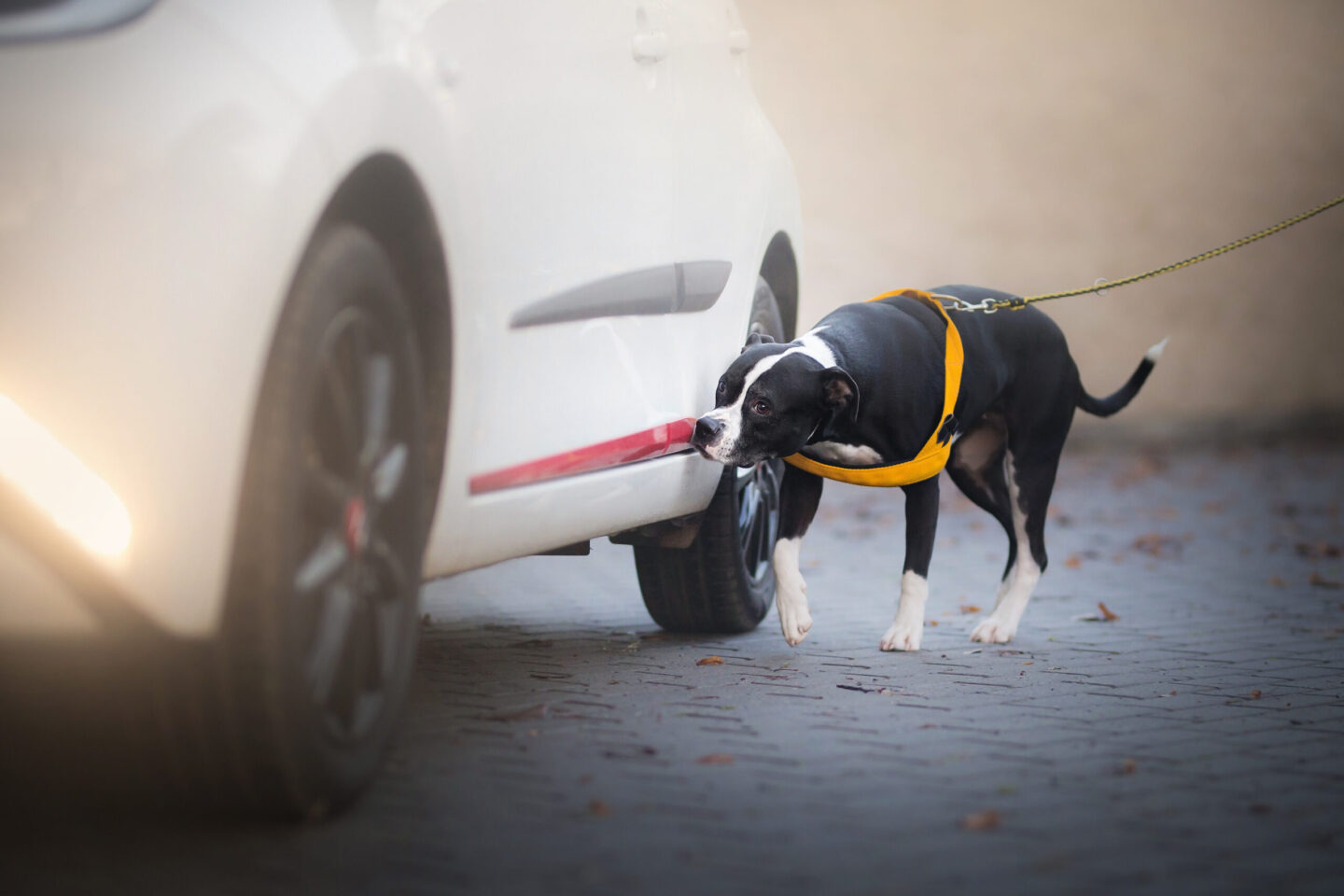
A dog investigating odor around the rear bumper of a vehicle while working on leash
Plan the scent problem and the handler’s route before the learner enters the search.

Design a search that answers one question

  • Plan the scent picture
    Use accessibility, airflow, surfaces, odor strength, aging, and start location as deliberate variables.
  • Read the whole chain
    Observe the start line, movement, change of behavior, source, indication, reinforcement, and end of search.
  • Audit the handler
    Separate what the learner detects from the information added by line handling, body position, path, and timing.

Harder hides do not automatically produce better training

A difficult search can be exciting and still answer no useful question. If hide accessibility, odor strength, aging, search duration, airflow, visual information, and handler behavior all change together, success and failure are equally difficult to interpret.

Stage 2 begins with a baseline. You will decide what each search is meant to teach, hold the other features as stable as the environment permits, and record the first point where behavior differs from your expectation. That difference becomes the starting point for the next plan—not an invitation to add another hide or give more directional help.

The search-design method

  1. State the training question. Decide which part of the chain or scent picture the setup is meant to develop.
  2. Plan the environment. Record location, surfaces, airflow or ventilation, hide accessibility, strength, aging, and start line.
  3. Plan the handler. Decide on line handling, movement, access, observation position, and the end-of-search routine.
  4. Run and record. Observe the first meaningful change in behavior rather than summarizing the search as good or bad.
  5. Choose the next exercise. Distinguish a scent-physics question, a missing learned link, handler influence, physical difficulty, or missing information.

Your six-week learning map

Week 1 · Define the search chain

Establish a baseline, map the behavior chain, use ABC relations, build a start-line routine, plan aging, introduce the search, and begin measuring search duration.

Week 2 · Add scent theory and exterior foundations

Examine odor movement and accessibility, then introduce controlled exterior searches with boxes and a single accessible hide.

Week 3 · Develop the handler’s role

Analyse line handling, movement, access, and observation; introduce vehicle-search foundations; and reduce dependence on visual information.

Week 4 · Clarify vehicles and cues

Work with a cold vehicle and examine the cues that enter the routine. Treat vehicle work as a safety-sensitive arrangement rather than simply another object to circle.

Week 5 · Extend the search without losing the chain

Develop search duration, vary handler behavior deliberately, and add complexity while monitoring independence and indication clarity.

Week 6 · Change odor conditions and plan the next search

Reduce odor strength, increase aging time, complete the duration progression, write training plans, and troubleshoot cases without changing every variable at once.

Tools for every search plan

  • a baseline and repetition-boundary record;
  • a start-line and end-of-search plan;
  • hide accessibility, odor strength, and aging fields;
  • environment and airflow hypotheses;
  • line-handling and handler-movement notes;
  • observable change-of-behavior records;
  • reinforcement placement; and
  • a before-and-after comparison that identifies the first divergence.

See a search in motion

Watch the full sequence rather than only the moment at source. Follow the start, search path, changes in behavior, handler movement, indication, and the end of the repetition.

Readiness and scope

Before beginning, the learner should have a usable indication on target odor, basic hot-versus-cold discrimination, experience with more than one holder or location, and a simple search cue or routine. Equivalent prior training is suitable when those components are already established. If you need that foundation, begin with Introduction to Nosework.

Stage 2 develops accessible single-hide exterior and vehicle foundations. It provides trial foundations, not universal trial readiness. Multiple-hide strategy, every inaccessible-hide problem, all interior scenarios, distractor rules, and organization-specific test requirements are outside its scope. Weather, surfaces, odor materials, vehicles, local rules, and the learner’s health require individual safety decisions.

What students from earlier editions say

Earlier editions included different participation and support routes. These comments describe students’ experience with the course.

“Another super course focusing on important foundations to build motivation, confidence and understanding.”

— Jennifer Will

Your instructor

Agnieszka Janarek is the founder of Tromplo and an animal trainer with a background in Applied Behavior Analysis. Her nosework teaching connects scent physics with learning history, careful observation, and the trainer’s own behavior inside the search.

I do not want you to collect harder hides. I want you to design a search, state the question it should answer, and identify the first point where the learner’s behavior tells you something different.

Agnieszka Janarek and a dog raising one front paw toward each other

Build the complete search chain

US$139 · six-week Auditor / self-study course · one year of access.

You receive written lessons, video demonstrations, practical exercises, and a reusable route for planning, running, recording, and revising accessible single-hide searches.

Join Nosework Stage 2

Questions before you enrol

Can I begin without Stage 1?

Yes, if the learner already has an equivalent foundation: a usable indication, basic odor discrimination, variation across holders or locations, and a simple search cue or routine.

Will this make us trial-ready?

The course develops trial foundations for accessible single-hide exterior and vehicle searches. Readiness must still be evaluated against the rules and conditions of the organization and venue where you plan to work.

Does the course cover vehicle searches?

It introduces vehicle-search foundations and a cold-vehicle exercise with explicit attention to safety, cue clarity, access, and handler movement.

Does this offer include individual review?

This is the Auditor / self-study route. It includes the complete materials, demonstrations, exercises, and one year of access.

Course Testimonials

I love this course! It was fantastic continuation of stage 1, where we learn basic behaviours and concepts. On this course, I understood the nosework much better, as well as my dog. It was very packed with knowledge and very inspiring for practise developement. We gain new skills so we can play nosework much more widely and be more creative. Agnieszka gave us tools how to solve problems, progress and make searches more interesting, challenging or just more fun. I learn how to progress and regress exercises, on what aspects I need pay more attencion and how to solve problems. We were working on observation skills, but also on my behaviour, that influence all process of searching and communication. It was awesome to observe that Fredzio is gaining new skills, become more and more confident and all this brings him good fun <3 After this course, I think me and Fredzio are much better nosework team…on the other hand, I see many more aspects and skills that we should work on…I want more 😀 After taking this course for shure I will continue nosework learning jurney with my dog 🙂

Thank You very much Agnieszka!

Janina Gmiter

April 15, 2024

Another super course focusing on important foundations to build motivation, confidence and understanding. Just perfect for my cocker who has improved dramatically over the 6 weeks. We’ve both loved it and will be eager to do more scentwork courses when they pop up. Thanks so much Aga!

Jennifer Will

June 30, 2023

Lessons:

  • Week 1 01 Aug 2026

    • Before You Begin: The Search Is a Chain

      Stage 2 begins where an isolated indication ends. The question is no longer only whether the learner can alert on…

    • Baseline

      Before we start and dig deeper into course content, I would like to see where you are right now. I usually…

    • Chains in nosework

      The search pattern is a classic example of backchaining.   When working with dogs you often hear the term ‘behavior chain’.

    • ABCs of the search

      We have already deciphered behaviors that are part of the search chain. Now it’s time to use this knowledge. We…

    • Our variables

      What variables can we change to target the start line routine and efficiency of the search?  For our current work,…

    • Start line routine

      This is a part of the lesson in stage 1. I have added some new information – so even if…

    • Aging

      Until now, this is how our searches looked like: – you placed the hide in the room, – let the…

    • Introducing search

      The crucial element that is often forgotten is how we introduce searches to our nosework dogs. For me the ideal…

    • Duration of the search part of the chain

      We are now after over a week of doing searches with scent as a start cue.  If your dog starts…

  • Week 2 08 Aug 2026

    • Introduction to scent theory

      Why do we need scent theory? Because it directly influences the learning process.  We set up puzzles to target particular skills.

    • Inaccessible v. Accessible

      In nosework, you will encounter: – accessible hide – inaccessible hide – visible hide – invisible hide Very often two…

    • Introducing exteriors – boxes on the road

      Exteriors can be complicated for many reasons; wind, temperature, changing weather conditions, environmental distractions. The impact of all these factors…

    • Introducing Exteriors: single hide

      After you had some practice with tins or boxes outside, we can introduce exterior searches.   Until you are fluent with…

  • Week 3 15 Aug 2026

    • Handler’s job

      One of the widespread tendencies that can be noticed in nosework trials in Poland is the excessive interference of the…

    • Vehicles – introduction

      This week we will start the vehicle adventure!  Please check your venue’s rules regarding this element.  Introduction to vehicles will…

    • Adding complexity to the search

      As you are working on increasing the duration part of the search chain, we can introduce some complexities. Objective: Dog…

    • Change of behavior

      Nosework is a team sport. Although we put a lot of emphasis on the independence of our dog during the…

    • No visual cues

      This exercise targets relying on scent cues more than on visual cues.  Some dogs have an issue with this task…

  • Week 4 22 Aug 2026

    • Vehicles – cold vehicle

      This exercise should only be done if your dog is fluent in wrapping around a single-vehicle.  Today we will introduce…

    • Cues in nosework

      What is a cue? This is an excerpt from the lesson from my course Trainer’s Toolbox.  A cue is a…

  • Week 5 29 Aug 2026

    • Duration of the search part of the chain, part 2/3

      The previous step focused on searches in the corridor, the location that blocked side trips. Today we are removing one…

    • Crazy handler

      Dogs pay very much attention to our movement. At the training, we care not to…

    • Adding complexity to the search part 2/2

      Pooling odor is the theme of this lesson. This is the most common phenomenon your dog will encounter as you…

  • Week 6 05 Sep 2026

    • Reducing strength of odor and increasing aging time

      We can divide complexities one may find in nosework puzzles, into two categories.   Handler dependent factor:   aging accessibility  strength…

    • Duration of the search part of the chain, part 3/3

      One of the very important skills to have for a nosework dog is to maintain duration on the search part…

    • Planning

      The training sessions should always be planned. But in nosework, we often forget about it. We treat this activity differently…

    • What if?

      Things don’t always go as planned. Technically this is not a problem, not until we make it a problem. Errors…

    • Final Lesson: Design the Search, Then Read What Happened

      Final lesson: design the search, then read what happened You have now worked with the complete search chain: start line,…

    • Final Lesson: Design the Search, Then Read What Happened

      Before you place a hide, decide what question the search is meant to answer. After the search, ask whether the…

Free Lesson