


Do Dogs Need to Make Mistakes to Learn?
 Agnieszka
Janarek
Agnieszka
Janarek
What errorless-learning research actually shows—and what it does not
Do dogs need to make mistakes in order to learn?
I hear two versions of this argument very often. The first is that mistakes provide the information necessary for learning. The second is that a learner has to experience frustration in order to build resilience. Both statements collapse several different processes into one idea: an incorrect response in a discrimination, ordinary variation during shaping, a response that does not meet the trainer’s current criterion, and a previously reinforced behavior contacting extinction. These are not the same thing.
An error is not a character trait, and it is not a special ingredient that must be added to learning. It is our description of a response in relation to a criterion or contingency. In a discrimination experiment, an error may be defined as responding to the stimulus correlated with no reinforcement. In shaping, trainers often use the same word for any response that does not meet the current criterion. Before discussing whether errors are necessary, we should therefore be clear about what we are calling an error.
“The implication that learning occurs only when errors are made is false.”
B. F. Skinner, The Technology of Teaching (1968)
Dogs can certainly learn after making an error, but this is different from saying that errors are required or that repeated failure should become our teaching procedure.
Extinction is a contingency; frustration is not
Operant extinction occurs when a response that previously produced reinforcement no longer does so under the relevant conditions. During that transition, behavior may change. We may observe changes in response rate, intensity, latency, or variability. Previously reinforced behavior may reappear, which we call resurgence. The learner may also pause, move away, or stop responding.
These effects are possible, not mandatory. An extinction burst is not an unavoidable stage that every learner must pass through. Experimental work shows substantial variation in whether and how such increases occur. More importantly, frustration is not simply another word for extinction. Extinction describes an arranged relation between behavior and its consequences. Frustration describes an interpreted affective state. Lattal, Kuroda, and Cook (2020) discuss this variability in the experimental literature.
We can observe whining, barking, freezing, moving away, scratching, sniffing, repeated responses, or nonresponses. We can define and measure those behaviors. We may describe them as frustration-related when the context and operational definition justify that term, but one behavior does not prove one internal state. The learner’s history and the complete context still matter.
If I want to build persistence, tolerance of a delay, or the ability to return after an interruption, I need to define and teach that behavior. Repeatedly withholding reinforcement is not automatically a curriculum for resilience.
What does errorless learning actually mean?
One classic errorless-learning procedure comes from Herbert Terrace’s 1963 discrimination experiments with pigeons. The response to the reinforced stimulus was established first. The stimulus correlated with extinction was introduced early, initially in a weak or brief form, and gradually faded in. The pigeons learned the final discrimination with few or no responses to that second stimulus. Responding to it was not required for the discrimination to develop. Read Terrace’s study.
This is more specific than simply “setting the learner up for success.” It is a teaching procedure involving carefully arranged stimuli and systematic fading. In applied animal training, we often use “errorless” more broadly to describe an error-minimizing approach: building prerequisite behavior, arranging antecedents, selecting achievable approximations, using prompts when useful, fading assistance thoughtfully, and changing the plan before repeated failure becomes the teaching method.
That distinction matters. Errorless learning is not a promise that no mistake will ever occur. It describes what the teacher arranges, not a perfect outcome the learner must produce.
What did the pet-dog study find?
In 2023, Kimberley Handley, Susan Hazel, Jade Fountain, and Eduardo J. Fernandez published the first direct comparison of an errorless-learning fading procedure and trial-and-error training in pet dogs. The dogs were taught to nose-touch one of two colored circles.
In the errorless condition, the correct stimulus was established first and the incorrect stimulus was gradually faded in. In the trial-and-error condition, both stimuli appeared at equal salience from the beginning: responses to the correct stimulus produced food, while responses to the incorrect stimulus did not.
The errorless-learning dogs produced more correct responses, fewer nonresponses, and substantially fewer behaviors the researchers had operationally defined as frustration-related. Their performance also showed faster acquisition. Three of the four dogs in that group reached the learning criterion, compared with one of the four trial-and-error dogs.
But “errorless” did not mean that those dogs made no errors. They did not make fewer incorrect responses in this study. They responded more overall, and the errorless group produced 116 incorrect responses across 279 trials, compared with 71 across 197 trials in the trial-and-error group. The between-group difference in incorrect responses did not meet the study’s corrected significance threshold.
This is an important nuance. The useful finding is not that the procedure magically removed mistakes. It changed the broader pattern of learning: more correct responding, fewer nonresponses, fewer frustration-related behaviors, and faster acquisition in this specific task.
The evidence is also preliminary. Twenty-four dogs were recruited, but only eight reached the final phase and were included in the comparison. We should not turn four dogs per condition into a universal rule for every learner, behavior, or environment. The study gives us a valuable direction and a reason for further research—not permission to overstate what is known. Read Handley et al. (2023).
What changes in practical training?
For me, the practical implication is not that I must prevent every possible error. It is that I do not need to build repeated failure into the plan. I can take more responsibility for the conditions under which learning occurs.
That means defining the behavior in observable terms, checking that the learner has the necessary component skills, arranging antecedents so the useful response is likely, planning reinforcement delivery and the transition into the next repetition, and fading prompts or challenges gradually. When the same unsuccessful response keeps occurring, allowing more identical trials to accumulate is not the only option. I can stop and change the teaching arrangement.
Variation still matters. Shaping would be impossible without differences between responses. But variation is not the same thing as leaving the learner in an unclear contingency and waiting for success to emerge from repeated nonreinforcement.
So, does a dog have to say “no” in order to learn “yes”? Not as a universal requirement. Mistakes will happen, and they can give the teacher information. That does not mean the learner needed them, or that frustration should become the mechanism through which we teach.
Errorless training is not flawless training. It is the decision to design for useful success, observe carefully, and change the plan without blaming the learner.
Learn the complete shaping system
If you want to work through this as a complete training system, Shape Me Up! is my six-week course on error-minimizing shaping. We look at observable behavior, prerequisite skills, antecedent arrangement, criteria, reinforcement delivery, stimulus control, and the complete loop between one repetition and the next.
Explore Shape Me Up! — Errorless Shaping
The current self-study edition costs $139, includes one year of access, and closes for registration on August 14, 2026. Individual feedback is not included.
Reference
Handley, K., Hazel, S., Fountain, J., & Fernandez, E. J. (2023). Comparing trial-and-error to errorless learning procedures in training pet dogs a visual discrimination. Learning and Motivation, 84, 101944. https://doi.org/10.1016/j.lmot.2023.101944
See also other posts:
August 4, 2026

Why Your Dog Starts Offering Every Familiar Behavior During Shaping
Your dog sits, paws, spins, lies down, and offers every familiar behavior during shaping. Trace reinforcement history and the changed contingency before labeling the learner.
August 4, 2026
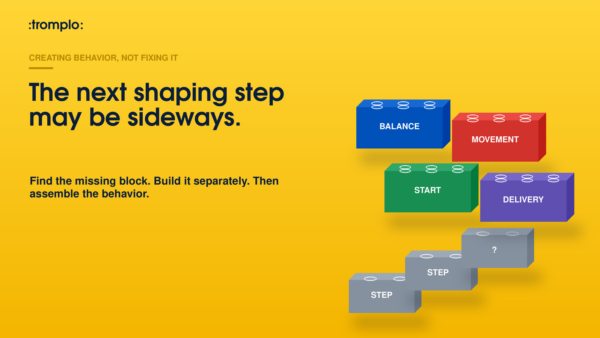
Creating Behavior, Not Fixing It: Shaping Through Component Skills
Treat complex behavior as a structure: teach useful component skills separately, plan the joins, and assemble them without asking the learner to guess the whole answer.
June 30, 2023

Get Your Lost Dog Back Home Quickly: Follow These 12 Tips for Success
Vacations favor more frequent and longer walks with our furry friends. We travel, visit new places. Summer makes us loosen our brakes and allow our…