

Dog Shaping Stuck? Five Things to Check Before Lowering Criteria
 Agnieszka
Janarek
Agnieszka
Janarek
When a shaping session stops progressing, the advice usually arrives quickly: lower the criterion, split the behavior into smaller steps, and try again.
Sometimes that is exactly what the training needs. But a smaller criterion does not repair a reinforcement-delivery pattern that sends the dog in the wrong direction. It does not make sticky food leave your fingers. It does not give the learner a movement pattern they have never acquired. And it does not make the trainer’s mechanics suddenly fluent.
This is why I do not want “make it easier” to become our only troubleshooting tool. If the same problem returns as soon as we try to move forward, the size of the step may not be the source of the problem at all.
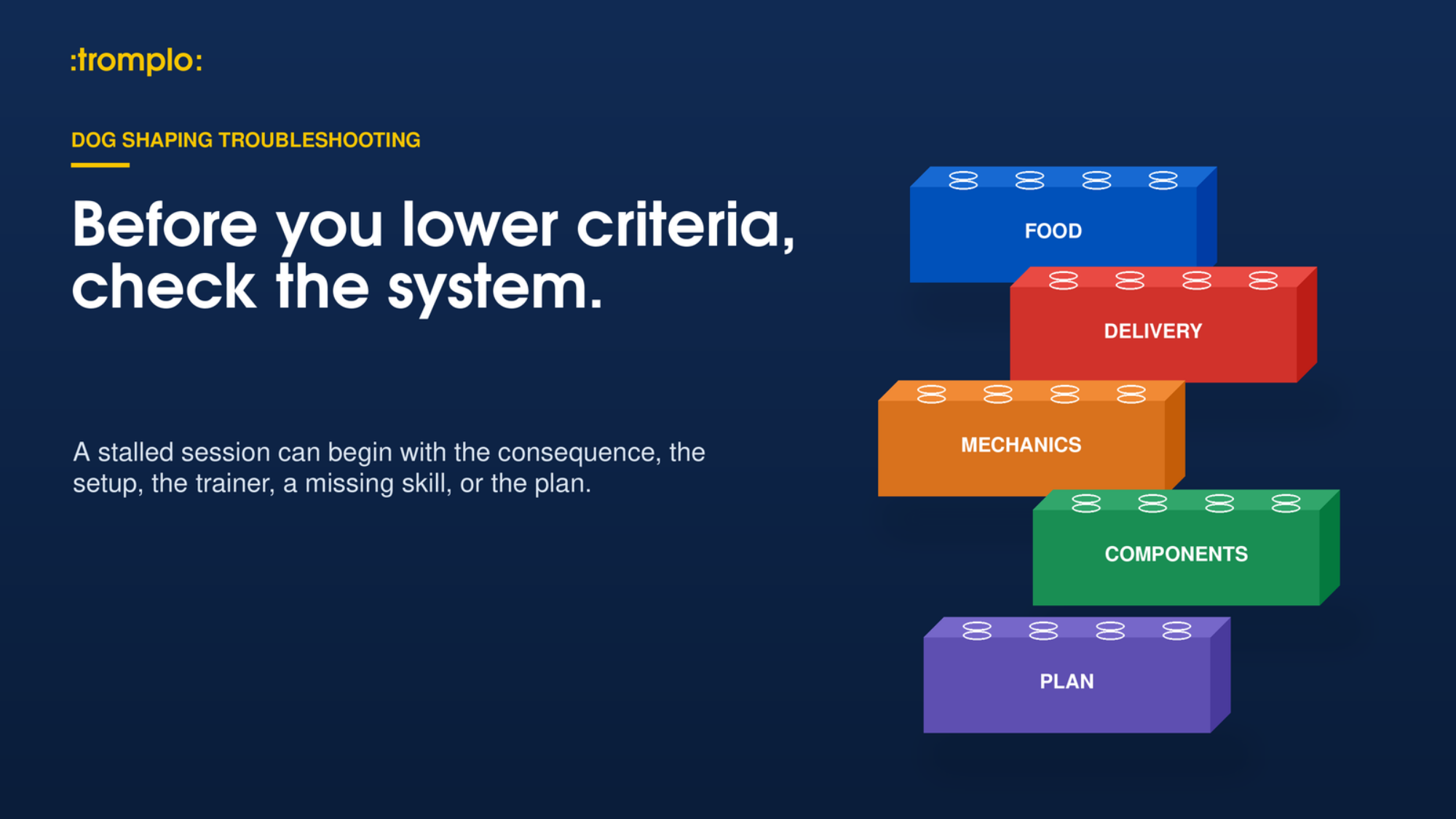
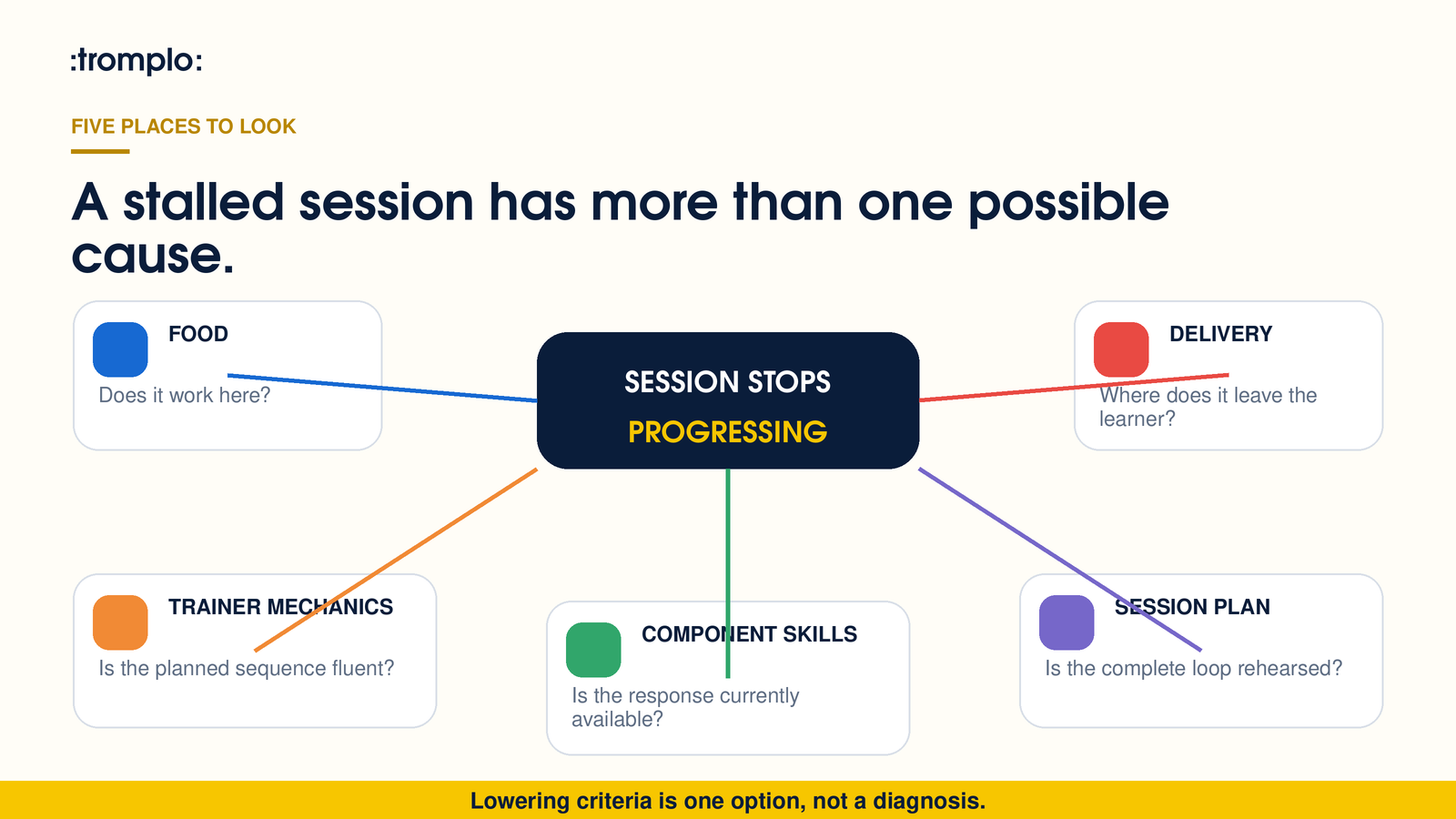
Before lowering criteria again, I check five things.
If the stall appears as a rapid sequence of sit, paw, down, spin, bark, or other familiar responses, start by tracing what changed in the contingency. Why a dog offers every familiar behavior during shaping shows how reinforcement history can guide the next setup.
1. Is the food compatible with this behavior and this delivery pattern?
Food is not automatically a reinforcer simply because it is edible. Its function depends on the learner, the behavior, the context, and what happens after it is delivered. Even when food is functioning as reinforcement, its physical properties can quietly dismantle an otherwise good training plan.
Imagine that I plan to toss one piece of food behind the dog so the next repetition can begin from a useful position. I mark the response, move my hand, and the sticky piece of hot dog remains attached to my fingers. The dog has already followed the movement that normally predicts the toss, but the food has not appeared where expected. I repeat the gesture, the dog moves again, and the clean reset I planned no longer exists.
The opposite problem is just as common. I reach into the pouch intending to deliver one piece and come out holding several greasy pieces. I try to separate them while the dog follows my hand, changes position, or starts taking food roughly. Or I use a large, crunchy treat in a high-rate session and spend more time waiting for chewing than observing behavior. Tiny food scattered into grass can turn a five-second reset into a long search.
None of these are small details. They change the sequence the learner experiences.
Before the session, ask:
- Can I pick up and deliver one piece without looking?
- Is the food easy to toss accurately if tossing is part of the plan?
- Can the learner find it quickly on this surface?
- How long does eating take relative to the pace I need?
- Does this food still function as reinforcement in this context?
If the consequence is slow, unpredictable, difficult to locate, or not currently reinforcing the behavior, lowering the criterion will not solve the right problem.
2. Does the delivery pattern support the next repetition?
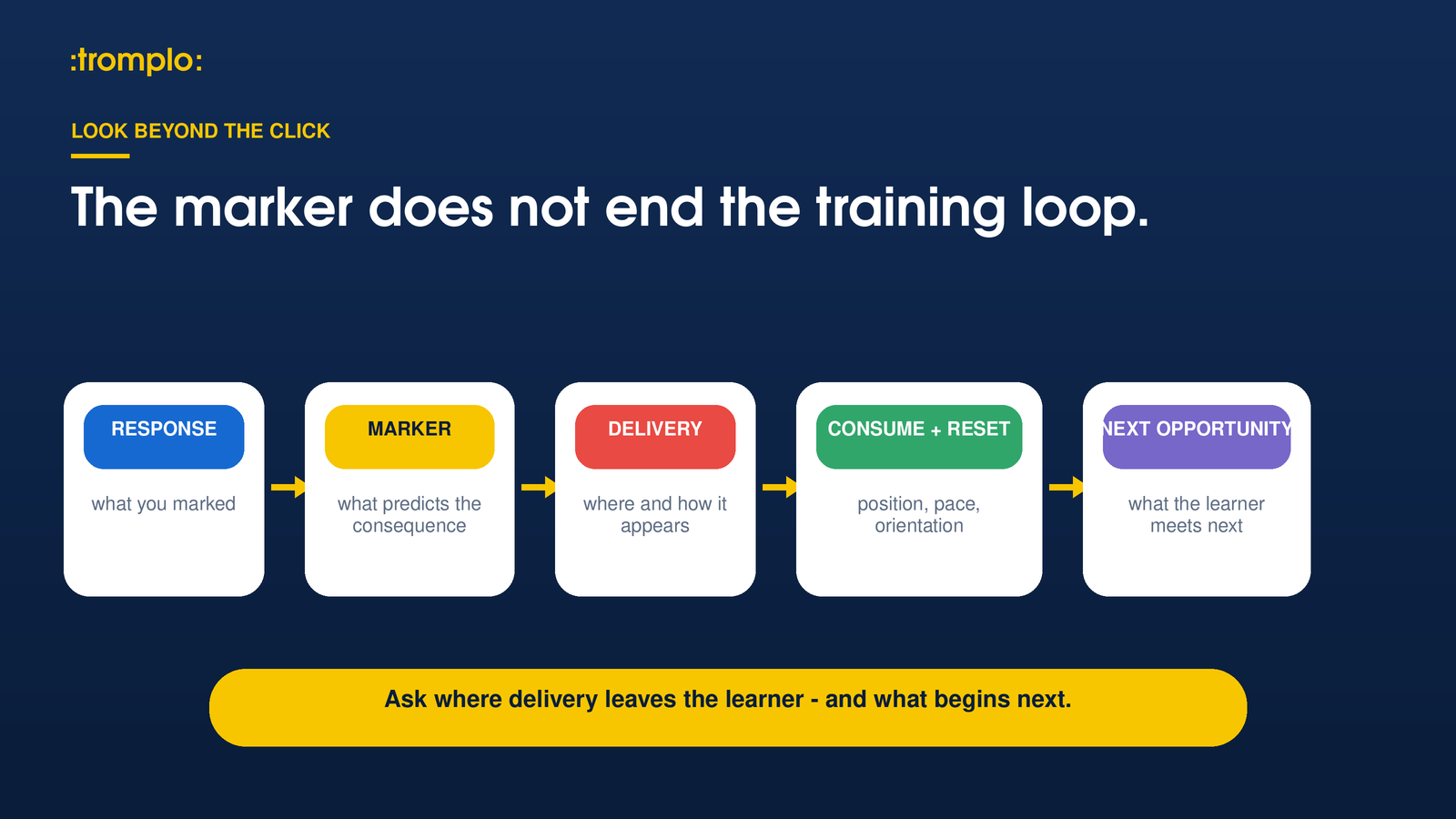
The marker does not end the training loop. Where and how I deliver the consequence affects the learner’s position, direction, pace, and readiness for whatever happens next.
If I reinforce a stand by repeatedly moving food toward my body, I may build forward movement into the loop. If I want the dog to remain in heel position but consistently begin reaching toward the pouch before the marker, my movement may become a cue to leave position. If a tossed treat is supposed to reset the dog for another approach but lands at an awkward angle, the next repetition begins from a different antecedent arrangement than I planned.
The useful question is not only, “Did I reinforce the behavior?” It is, “What did the complete delivery teach, and where did it leave the learner?”
A delivery pattern should be a skill for both participants. The learner needs a history with the pattern, and I need enough fluency to perform it while I continue observing. If the pattern is new, I teach or rehearse it separately before asking it to carry a difficult criterion.
Watch one full loop:
- What response did you mark?
- What did your body do immediately afterward?
- Where did the consequence appear?
- What did the learner do while consuming it?
- In what position and orientation did the next opportunity begin?
That fifth question often explains why the first repetition looks beautiful and every later repetition deteriorates.
If this is the part of training you want to study in depth, Strategic Reinforcement Delivery for Dog Trainers examines the complete sequence from response and marker cue through delivery, consumption, transport, reset, and the next opportunity.
3. Are my mechanics fluent enough for the plan I wrote?
Training involves two learners. The human is not standing outside the contingency.
We drop food. We reach into the pouch too early. We mark while our body is already moving. We toss the clicker instead of the treat – or both at once. We look at the prop, lean forward, step sideways, hold our breath, change the angle of our shoulders, and then wonder why the dog’s behavior changes.
If a dog repeatedly drops their head during heelwork, I want to know whether I have repeatedly dropped food. If the dog launches toward my hand, I want to see how I have presented it and what that movement has predicted. If the learner responds before the cue I intended, I want to inspect the reliable cues I may be providing without noticing them.
Video is extremely useful here, but watch it differently. Instead of replaying only the dog’s response, mute the recording and cover the learner with your hand. Watch yourself.
- When does your hand begin moving?
- Can you mark without changing posture?
- Where are your eyes?
- Are you ready to deliver before the response occurs?
- Can you execute the reset while still observing the learner?
- What movement reliably happens before every “unexpected” response?
Then rehearse without the dog. Use an empty bowl, a target on the floor, or a human assistant. Practise holding, marking, reaching, delivering, and resetting until the sequence no longer consumes all of your attention.
This is not about blaming the trainer. It is about recognizing that trainer behavior is trainable too. When mechanics improve, the learner receives clearer information.
4. Is a component skill missing?
This is the check that most often changes how I see a stalled shaping plan.
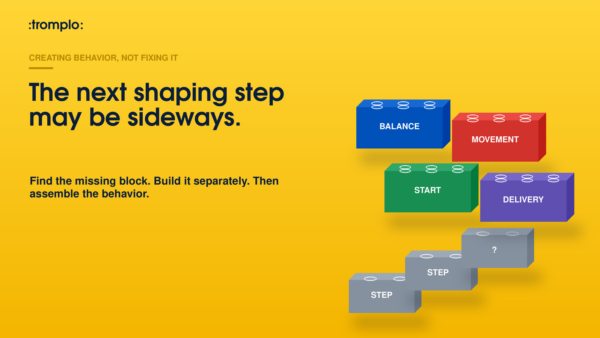
We tend to imagine shaping as a staircase: reinforce one approximation, then the next, then the next. When the learner cannot climb the next step, we lower it. But many complex behaviors are easier to understand as LEGO structures. They are assembled from behavioral components that can be taught, strengthened, and tested separately.
Take a heel-position pivot. The final behavior may require side-stepping, backing, balance, a stable start position, orientation to the handler, and the ability to move the rear end while the front feet remain on a target. If the dog cannot step sideways outside heel position, making the pivot criterion smaller does not create side-stepping. If the learner cannot stand still with useful balance, a tenth session of asking for one isolated rear-paw movement may simply reproduce the same problem.
The missing block may be:
- a movement pattern;
- balance or physical ability;
- a stable base position;
- interaction with a prop;
- a start or station behavior;
- a delivery or transport skill;
- stimulus control over a component that will later become part of a chain.
This does not mean every stalled session is a fitness problem or that every response requires a complex prerequisite curriculum. It means we should ask whether the current approximation is genuinely available to this learner under these conditions.
Sometimes the most efficient way forward is to stop shaping the whole behavior. Teach the missing component in a simpler context, bring it to useful fluency, and then return to the larger structure. Lowering criteria changes the size of the request. Teaching a missing component changes what the learner can do.
5. Have I rehearsed the complete session, not only the target response?
A plan can be flexible and still be a plan.
Before I train something new, I want to know more than the response I hope to mark. How will the session begin? How will the learner reach the start position? What exactly is today’s criterion? Where will reinforcement be delivered? What position will that create? How will the next repetition begin? What will I do if the response does not meet the criterion? Where can the learner pause, and how will the session end?
Flowcharts are rehearsals on paper. They reveal missing skills and awkward transitions before the learner has to experience them.
A small public version can be as simple as this:
Start position -> current criterion -> marker -> delivery -> reset or transport -> readiness -> next repetition
Add two branches:
- If the learner does not begin: pause, observe, and check the antecedent arrangement rather than repeating the same cue.
- If the response differs from the plan: reset safely, record what happened, and decide whether the next session needs a setup change or a component skill.
The purpose is not to control every second or make the learner robotic. Acclimation, breaks, opt-out behavior, and exploration can all be meaningful parts of a session. Planning means I know why they are there and what I will do next. It prevents the dead time in which the trainer searches for food, moves props, improvises a reset, and leaves the learner to solve a contingency that was never designed.
Lowering criteria is one option, not a diagnosis
When a session stalls, I may still lower the criterion. But I want that to be an informed change, not a reflex.
First I check the consequence, the delivery pattern, my mechanics, the learner’s component skills, and the complete session plan. If the current approximation is simply too large, splitting it will help. If the missing piece is elsewhere, I want to change the part that is actually producing the problem.
An unsuccessful response is not evidence that the learner is stubborn, careless, or unwilling to try. It is information about the behavior-environment relation we arranged. The most useful question is not, “How do I make the dog try harder?” It is, “What would make the next useful response more available and more understandable?”
That is the kind of question that turns shaping from guessing into teaching.
Build the complete shaping system
Shape Me Up! – Errorless Shaping is my complete six-week system for observing behavior, identifying component skills, planning criteria and reinforcement delivery, rehearsing the training loop, and troubleshooting without making repeated failure the teaching method.
Errorless does not mean flawless. It means we design for useful success, notice problems earlier, and change the plan without blaming the learner.
See also other posts:
August 4, 2026
Why Your Dog Starts Offering Every Familiar Behavior During Shaping
Your dog sits, paws, spins, lies down, and offers every familiar behavior during shaping. Trace reinforcement history and the changed contingency before labeling the learner.
August 4, 2026
Creating Behavior, Not Fixing It: Shaping Through Component Skills
Treat complex behavior as a structure: teach useful component skills separately, plan the joins, and assemble them without asking the learner to guess the whole answer.
June 30, 2023
Get Your Lost Dog Back Home Quickly: Follow These 12 Tips for Success
Vacations favor more frequent and longer walks with our furry friends. We travel, visit new places. Summer makes us loosen our brakes and allow our…