

Free shaping case · With Agnieszka Janarek
Your dog didn’t read your training plan.
So how does your setup make the next move available?
About 15 minutes · Read and compare explanations · No signup required
The case evidenceDelivery patternsError-minimizing design
You have a platform, food, and a very reasonable idea. The dog has the arrangement in front of them. Those are not necessarily the same training plan.
In this case, we will look beyond the click: how a delivery pattern can help arrange the start of a response, which movement must already be available, and what error-minimizing design asks us to plan before the dog gets stuck. You will compare explanations and leave with a decision note—not a recipe to try on your dog. Allow about 15 minutes, with optional deeper analysis. That timing is an estimate, not a race.
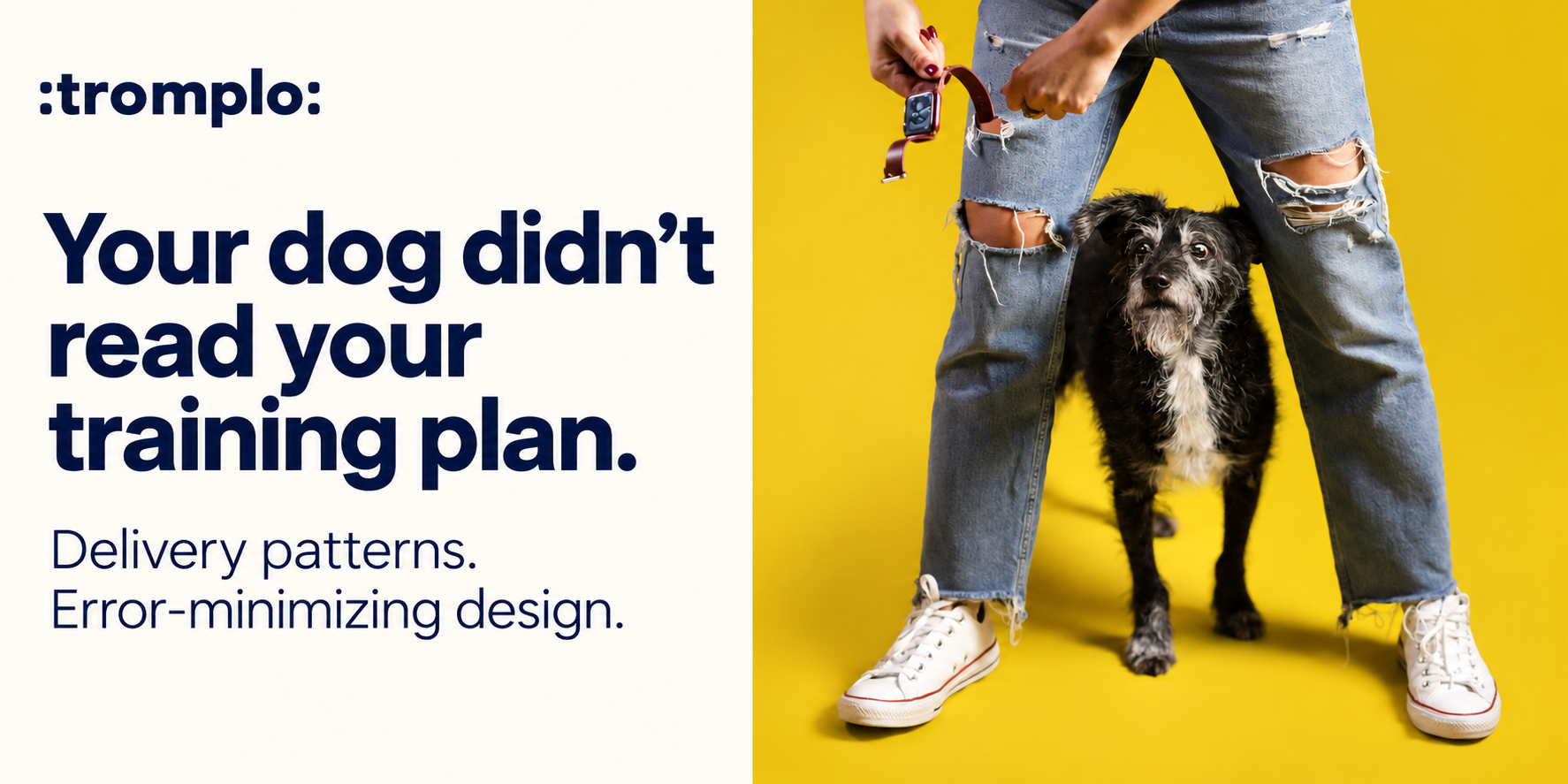
A fictional case for analysis—not a client result or a training prescription
In a quiet room, a dog has been placing both front paws on a low platform. At the next session, the trainer moves to another room, uses a taller platform, and wants all four paws on it. The dog places the front paws on the platform, then steps back. The trainer writes: “Knows the exercise. Loses motivation when I ask for more.”
One line in the notebook. Several claims hiding inside it. Efficient paperwork; less efficient analysis.
New to this way of looking? Start with the observable changes.
The room, platform height, and response criterion changed. Stepping back is described; a decrease in motivation has not been established. We also lack information about movement comfort, the surface, cues, previous consequences, and what happened between repetitions. This is a starting inventory—not yet an explanation.
Before seeing more: what do you think is happening?
Open the next piece of evidence
The easier version works. That does not finish the investigation.
The trainer’s existing recordings show a later return to the original room, original low platform, and original two-front-paw criterion. The dog again places both front paws on the platform. The trainer records: “Fixed it. Ready to ask for four paws again.”
Now look at the earlier footage. At every marked response in the recorded original session, both rear paws were still on the floor. The notes contain no observation of the dog moving the rear paws onto this platform from this starting position. This does not prove that the movement is absent from the dog’s repertoire. It means the claim that it is available here has not been checked.
The return to the old arrangement restored the old response. It did not show which of the three changes mattered, demonstrate the new movement, or establish that the next jump would now work. A successful repetition can be useful without answering the question we hoped it answered.
Which question would you investigate first?
Choose a working priority, not a diagnosis. Open a question to compare what it would—and would not—tell you.
Is the movement needed for four paws available from this starting arrangement?
A prerequisite question—not a diagnosis of inability.
Look for evidence of the required rear-paw movement and starting conditions in the existing record. Two front paws on the platform do not demonstrate that movement. Equally, not seeing it in this sample does not prove the dog cannot do it. This question helps identify what must be established before writing a progression.
Where does delivery leave the dog, and what movement does that make available next?
Delivery is part of the starting arrangement.
Review the whole sequence through delivery, eating, and the next opportunity. Record where the dog ends up and which movement follows. A familiar delivery pattern may help arrange an available response; it does not automatically teach a missing component or prove why the earlier attempt differed. The exact route depends on the learner, the task, and evidence of the skills needed to use it.
What response has this setup and reinforcement history actually established?
The old response may be exactly what this arrangement has taught.
Review which responses were marked and what followed them. A strong history for two-front-paw contact could matter when the trainer begins expecting a different response. That history does not, by itself, explain stepping back or rule out movement and surface factors. The useful question is how the proposed next response connects to what is already available.
Could the prop, footing, movement demands, or discomfort be relevant?
Safety can change the priority before teaching does.
Review the prop, footing, movement, and available health information. The case does not establish pain or an unsafe surface, but it does not rule them out. If there is evidence of a safety or health concern, pause the progression and address it; do not use repeated attempts to establish how much difficulty the dog will tolerate.
Would changing the food explain what happened?
A food change would change the situation—not explain the original one.
Food properties and consequences can matter. But if behavior changed after different food, that result alone would not demonstrate why the earlier attempt differed or establish that the new movement was already available. First clarify the response, conditions, and history. “Took the food” is also not proof that the whole arrangement is comfortable.
These possibilities can coexist. Choosing a first question is not the same as eliminating every other one.
Here is how I would reason through this record.
I would retire “knows the exercise” for the moment. Which exercise? Two front paws on a particular platform, from a particular position, with a particular history? That is not a pedantic distinction. It changes what I can reasonably expect next.
I would review the full sequence, not only the moment when the dog steps back: starting position, approach, paw movements, trainer movement, marker, food delivery, and what makes another repetition possible. I would look for existing evidence of the relevant movement and the conditions under which it occurs. An example on a different prop might be informative, but it would not automatically establish transfer to this one.
My provisional decision is to stop treating the four-paw response as a ready-made “next step.” The record supports a question about prerequisites and conditions. It does not yet select a specific exercise, food placement, or prompt. I would need those details before writing a plan for this dog. The dog does not owe us another failed repetition while we catch up with the paperwork.
Before the next click
Delivery can help start the behavior—not just follow it.
“Click, feed, repeat” leaves quite a lot hidden inside repeat. Where is the dog when eating ends? Which way are they facing? What movement is readily available from there? Delivery is part of that arrangement, not a catering break between the important bits.
A familiar, voluntary delivery pattern can help establish a useful starting position or movement. That can matter before the first target response as well as between repetitions. At the beginning, it is an antecedent arrangement—not reinforcement for a target response that has not happened yet. Later, what follows one response can help set up the conditions for another.
Consider two different jobs. If the goal is maintaining a position, a delivery pattern that supports staying there may fit. If the next opportunity depends on moving away and approaching again, we need a known route through that transition. Neither job tells us, by itself, exactly where to put food for this dog. A tossed treat is not a return policy.
In our platform case, I would examine delivery location, the route into eating, and the dog’s position afterward alongside the paw movements. Does the proposed pattern connect an available movement to the next criterion, or does it keep returning us to the same two-paw arrangement? The case record does not yet answer that. Changing delivery might be relevant; it is not a substitute for checking the missing movement.
If the proposed route depends on a separately taught transport skill, that skill needs to be familiar and voluntary. We cannot quietly add “learn how to get to the starting point” to an already new task and call the result a small step.
Design before difficulty
Errorless is a design question, not a promise of perfect repetitions.
Before asking for more, I want a readable starting arrangement, evidence that the relevant movement is available, and a criterion connected to that movement. I also want to know what delivery will do next. “We will see what the dog offers” is sometimes a description of our uncertainty, not a teaching plan.
For this case, writing “four paws” in the next box does not create a route from two. First we need evidence about the components and conditions. Then we can plan an attainable next response and how the learner will reach another clear opportunity. We also need a plan for a missed criterion, a pause, or leaving. Those events should not force us to improvise while the dog waits.
If the arrangement produces a miss, that is information for revising the arrangement—not a reason to repeat it unchanged until the learner discovers what we meant. Sometimes the missing piece is a component skill; sometimes it is the setup or a competing condition. Making everything vaguely “easier” need not address that particular gap.
Here, error-minimizing means designing to reduce avoidable errors and revising promptly when the evidence says the plan is not working. It does not mean guaranteeing zero errors or assigning the dog a success percentage they must maintain.
What evidence would change that decision?
| If the record showed… | I would update the question to… |
|---|---|
| The full movement already occurring under closely comparable conditions. | What differs at entry, in the cues, or between repetitions? A completely missing movement would become a weaker explanation, not an impossible one. |
| The front-paw response repeatedly marked, but no documented route into the rear-paw movement. | What history and prerequisite evidence justify expecting the new response? Absence from this recording still does not prove inability. |
| A shifting prop, slipping, or a change suggesting movement discomfort. | Is the arrangement safe, and is qualified health assessment needed? A training progression is not the first problem to solve. |
Go deeper: a successful repetition can answer the wrong question.
If the trainer counts “successful platform repetitions” before and after changing the criterion, the same label hides different responses. Two front paws and four paws are not interchangeable outcomes. Before interpreting a success rate, define the response, the opportunity, and the conditions being counted.
Returning to the familiar setup changed several things back at once. It can be a useful practical recovery, but it is not a controlled demonstration that height caused the earlier difficulty. Likewise, seeing a response after a cue does not establish that the cue controls it. The object, body position, and recent sequence may also matter.
Even a carefully chosen comparison only answers a bounded question. A one-off success would not demonstrate retention, transfer to another setting, or a particular emotional state. The goal is not to win an argument with the first hypothesis. It is to decide what you can responsibly do with the evidence you have.
Your challenge: write one sentence beginning “This observation would make me reconsider…” If no possible observation could change your explanation, you have written a conclusion, not a working hypothesis.
Leave with a decision note, not a verdict about the dog.
Use this fictional case or a recording you already have. You do not need to train your dog to complete the sample.
Compare with a completed decision note
“Two-front-paw contact is documented in the original arrangement. Four-paw movement from that start is not established. Relevant movement prerequisites, response history, and the conditions created by delivery remain questions. I would review complete repetitions—including the route into eating and the position afterward—before selecting a next criterion. I would not assume a different food location supplies an undocumented movement. The next plan needs an available component, a clear starting arrangement, a familiar delivery/transition pattern, and a planned response to a miss or pause. I would defer a harder attempt while safety or movement comfort is unresolved and preserve the learner’s ability to leave.”
From one case to your own training
Shape Me Up! is where we build the plan behind the decision.
This case shows the analysis. The course develops the practical work: describing the behavior, finding its component skills, choosing a starting arrangement, defining criteria, planning delivery and return, and revising the system when the learner gives you new information.
If your question is “How do I construct the next learnable step?” this is the relevant course to explore. Bring a behavior you want to build—not a dog you think should try harder.
See what Shape Me Up! teaches