
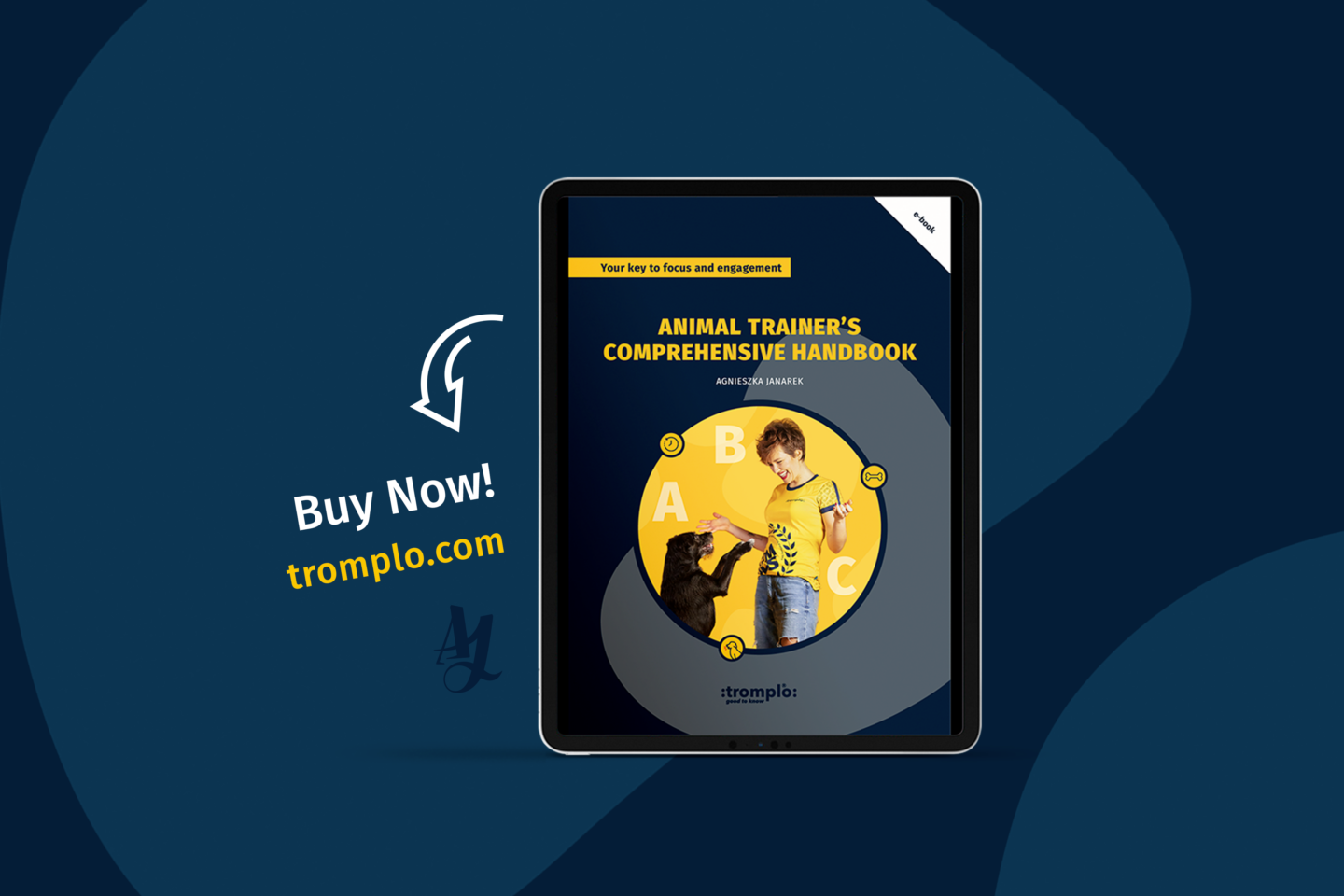
A practical guide to functional focus, engagement, and well-structured training sessions
Focus is not another word for eye contact.
Learn how to define the behavior you actually need, arrange clearer training conditions, and build sessions in which both you and your learner know what happens next.
PDF ebook · 77 pages · 17 connected lessons · $28
Learning is always happening. The question is what your session is teaching.
When a learner looks around, sniffs, walks away, responds slowly, or begins offering one behavior after another, it is easy to say they are “not focused.” But that label does not tell us what happened or what we should change.
Focus is not a fixed quality that an animal either has or lacks, and it is not always directed at the trainer. A dog tracking a scent or circling a cone may be completely engaged while looking away from you. In training, focus must be described through observable behavior that is relevant to the task.
This handbook helps you do exactly that. You will learn to look at the environment, the trainer’s behavior, the learner’s response, what happens after that response, and how one repetition creates the conditions for the next.
Instead of collecting disconnected exercises, you will build the foundations of a clear training session.
Many training problems begin between the behaviors we planned.
We tend to concentrate on the visible target: the spin, the recall, the position, the movement toward an object. But the rest of the session is teaching too.
How did the session begin? Was the learner ready to participate? What did your hands do before the marker? How was food delivered? What happened after it was eaten? Did the learner return ready for another repetition? What happened when you needed a break or reached for more treats?
The handbook brings those easily missed pieces into the training plan. It helps you build a session in which the setup, response, marker, delivery, transition, and next opportunity make sense together.
What you will learn
- Define focus through observable, task-relevant behavior rather than labels.
- Use antecedents, behavior, and consequences to examine what is happening in a session.
- Give a learner time to acclimate and choose a training environment at an appropriate level of difficulty.
- Observe food-taking and improve your own delivery mechanics.
- Introduce a marker without allowing your hands or the food to become accidental cues.
- Create clear ways to begin and end a training session.
- Observe latency and readiness for another repetition.
- Build cleaner, more repeatable ABC loops.
- Teach a response to a cue and the behavior of waiting before the cue appears.
- Introduce a formal break instead of leaving the learner without information.
- Connect behaviors into simple chains.
- Combine exercises without losing the structure of the session.
- Introduce distractions gradually, one relevant variable at a time.
- Use video and simple observations to make better decisions in subsequent sessions.
Seventeen lessons, taught as one progression
First, learn what you are observing
Explore operant learning, consequences, motivation, ethical training, and the difference between a label such as “unfocused” and behavior you can actually see and measure.
Then, prepare the training session
Work through acclimation, the trainer’s responsibilities, food-taking and delivery, markers, and clear ways to begin and finish training.
Build the learning loop
Add responses to cues, ABC analysis, clean loops, movement with the trainer, planned transitions, waiting for cues, and formal breaks.
Add complexity deliberately
Connect behaviors into chains, combine exercises, change contexts, and introduce distractions without asking for several new challenges at once.
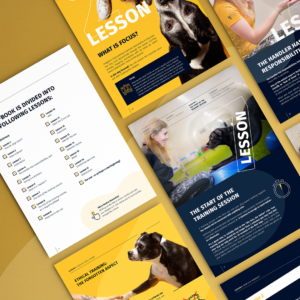
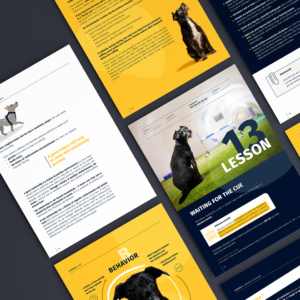
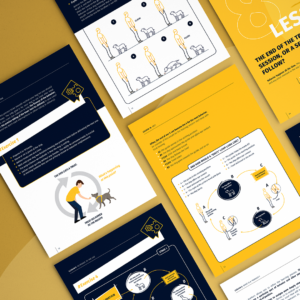
Each stage includes practical exercises, reflection questions, diagrams, flowcharts, and suggested observations. A linked contents page and internal navigation make individual lessons easy to revisit.
Start at the beginning. Return whenever a session becomes unclear.
This is a handbook to use, not something you have to read once and place on a shelf.
If you are new to systematic, reinforcement-based training, the sequence gives you a clear place to begin. If you already train professionally or participate in dog sports, it offers a structured way to revisit the foundations that often explain why advanced work becomes unstable.
Most examples involve dogs. The underlying questions—what happened before the behavior, what followed it, which behavior is relevant to the task, and how the environment affects participation—can also be applied when training other species.
This handbook is for you if:
- You want a clearer structure for your training sessions.
- “Focus” still feels vague or seems to disappear in new environments.
- Your learner performs well in one context but not another.
- You want to examine your own mechanics as carefully as the learner’s behavior.
- You prefer observable behavior and practical analysis to explanations such as stubbornness, impatience, or lack of motivation.
- You want a broad training foundation rather than a catalogue of tricks.
This handbook is not an individualized behavior consultation or an in-depth shaping curriculum. It will not give one universal recipe for every learner. It will help you observe more precisely, arrange the environment more thoughtfully, and make clearer training decisions.
From readers
“This book gave me clarity and a roadmap.”
— Mallary
“Great tips and reminders here for new and experienced trainers alike.”
— Sarah Owings
Choose the resource that fits your question
| Resource | Best choice when… | Scope |
|---|---|---|
| Handbook — $28 | You want a broad foundation for focus, engagement, cues, session structure, breaks, chains, and distractions. | 77-page practical reference with 17 connected lessons. |
| Errorless Shaping in a Nutshell — $45 | Your main question is how to plan and carry out shaping with fewer unnecessary errors. | Focused 2.5-hour shaping webinar. |
| Shape Me Up — $139 | You want to study shaping as a complete six-week system. | Deeper guided self-study course covering observation, modular teaching, written plans, criteria, troubleshooting, fluency, and stimulus control. |
These are separate offers, not steps in a paid upgrade ladder. None is required before purchasing another, and there is no course-price credit.
Build the session—not only the target behavior.
Seventeen connected lessons will help you see what happens before, during, and between repetitions, so you can replace vague judgments with a clearer training plan.
$28 · PDF ebook · 77 pages