

FOCUSED SELF-STUDY · START ANYTIME · 10 LEARNER MODULES · US$69
The session changed. Find the first thing that changed with it.
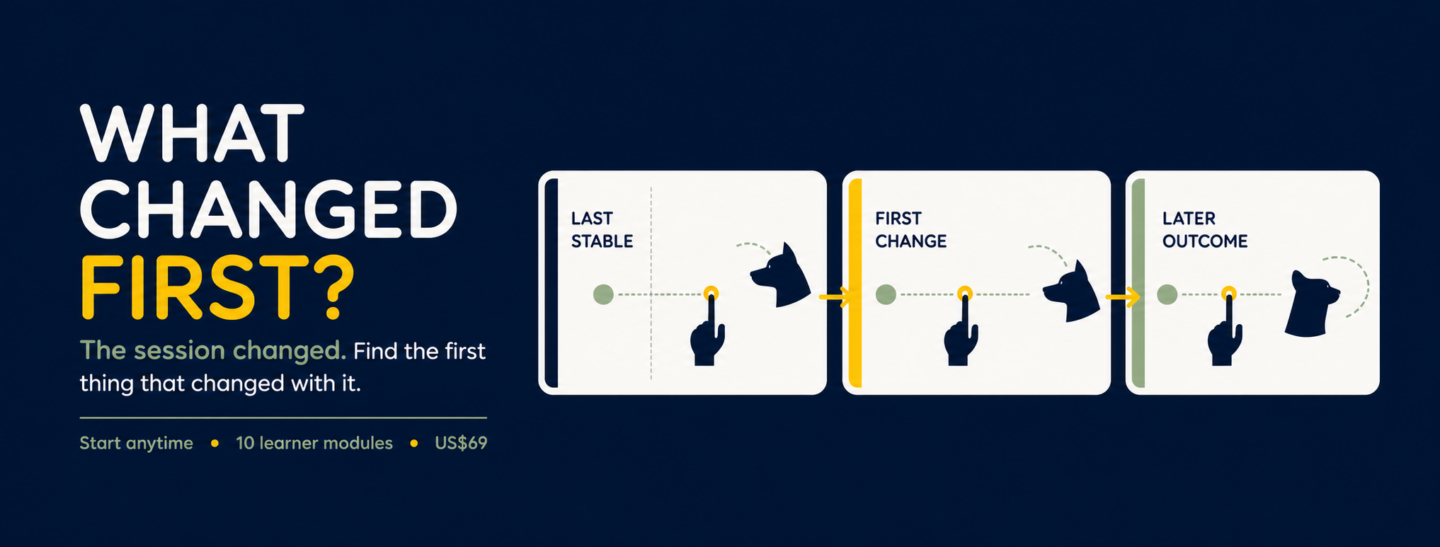
Use one short training sample to separate what happened from what you think it means, locate the earliest visible difference, and decide what evidence should come next—before you lower criteria, add prompts, or rebuild the whole plan.
- Start: anytime
- Format: focused self-study
- Access: one year
Start What Changed First? · US$69
Use your own safe training project or the supplied practice cases.
One short sample. Three useful points.
Cue → behavior → marker → food beside the trainer
Food hand moves before the next cue; the learner turns toward it
The next response differs from the planned behavior
Yesterday the behavior was there. Today, something is different.
The dog pauses before responding. Returns differently after reinforcement. Looks toward your hand instead of the intended cue. Offers a familiar behavior in a place where it did not appear before. Works in one room and not in another.
It is easy to call the dog distracted, confused, stubborn, or “not ready.” Those words may point toward a question, but they do not yet tell you what changed in the training arrangement.
The useful comparison is often much smaller: the last repetition that still worked as expected and the first repetition that did not. What could a camera record at that boundary? What changed in the antecedent, the trainer’s movement, the learner’s orientation, the consequence, the reset, the setting, or the timing? Which details are missing?
The most dramatic repetition makes better television. The first changed repetition usually makes better data.
One clip. Two plausible questions. The tiny detective hat can stay in the cupboard.
Constructed teaching example
In the first two repetitions, the trainer gives the cue, the dog performs the behavior, the marker sounds, and food is delivered beside the trainer’s right leg.
Before the third cue, the trainer’s food hand moves toward the pocket. The dog turns toward the hand, pauses, and then performs a different familiar behavior.
“The dog lost focus” is an interpretation. The sample gives us observations: the trainer’s hand moved earlier; the dog’s orientation changed; the next response differed.
That does not prove the hand movement caused the change. It gives us a better question. We could compare a repetition in which the hand remains still, examine what previously predicted food, or gather another sample under the same safe conditions.
The next step is not to diagnose the whole dog from four seconds of video. It is to decide which evidence would make one explanation more useful than another.
Turn one short sample into a defensible next question
- Describe before explainingSeparate camera-level observation from the story your very efficient human brain supplied.
- Compare close alternativesKeep two plausible working questions alive instead of marrying the first explanation.
- Choose evidence, not theatreIdentify one useful next observation or bounded test instead of changing everything.
By the end of the course, you will be able to choose three useful points in a short sample; distinguish observable descriptions, interpretations, and missing information; compare six training questions that can produce similar-looking later behavior; state what would support, weaken, or replace your working question; and complete a reusable Clip Review Record.
A better question is a useful outcome. Sometimes the correct decision is to collect more information. This is science, not speed dating for hypotheses.
A complete focused course, not a teaser for a larger one
10 learner modules
Orientation, five teaching lessons, final integration, a next-step guide, a materials hub, and completion.
Worked cases and graphics
Use supplied practice cases or one safe personal project; a perfect personal clip is not required.
Reusable review tools
Complete the Clip Review Workbook and practical records you can use after the course.
Two private self-checks
Use answer explanations and guided review to return to the exact distinction that needs more work.
Video examples are optional. Every teaching point is also available in writing.
Study one bounded question at your own pace
- Notice. Write what a camera and microphone could record.
- Locate. Find the last stable point and the first changed point.
- Compare. Name the two closest working questions.
- Discriminate. Ask what missing evidence would separate them.
- Decide. Choose the smallest safe next observation or test.
- Record. Add the decision to the Clip Review Record.
The work is deliberately bounded. One short sample cannot explain the whole learner, establish a diagnosis, or replace welfare, veterinary, or case-specific professional support. If health, fear, fatigue, distress, environmental pressure, or safety may be relevant, those boundaries come before a training exercise.
Choose this course if this is your question
A useful fit
- You review training video but do not know where analysis should begin.
- You are tempted to alter several parts of the plan at once.
- You want to describe behavior before assigning intention or emotion.
- You want a focused introduction to Tromplo’s evidence-led teaching.
Choose by the problem
If reliable behavior breaks only when time increases, examine Duration by Design. If you need a broader applied-behavior-analysis foundation, examine Behavior Geek. If the problem concerns constructing behavior through shaping, examine Shape Me Up!
Buying the largest course is not automatically the most scientific decision. We arrange antecedents for animal learners; we can extend the courtesy to our own calendars.
Questions before you begin
Do I need to submit my own training video?
You can use the supplied practice cases, so a personal video is optional. If you use a personal training project, keep it safe and within your competence and professional scope.
Is this a complete behavior assessment?
No. The method helps you examine one bounded training sample, distinguish observation from interpretation, and decide which evidence should come next. One clip cannot explain the whole learner.
What support is included?
The independent self-study edition includes worked cases, tools, graphics, two self-checks, answer explanations, and guided review. It is designed for independent study and does not include individual case feedback.
Is every teaching point available without video?
Yes. Video examples are optional; the complete teaching is also available in writing.
When can I begin?
Begin after purchase. This is a start-anytime focused self-study course, not a dated cohort.
Find the first change before changing the whole plan.
Study one short training sample carefully. Leave with a reusable review process and a more defensible next question.