

Six-week Tromplo self-study course
Shape Me Up!Errorless Shaping
Stop asking your learner to guess.
Learn how to observe, plan, build, and troubleshoot behavior without relying on endless trial and error, waiting the learner out, or treating frustration as a necessary part of learning.
Enroll in Shape Me Up!Auditor / self-study edition only — no individual feedback
Evidence-based. Practical.
Rooted in observable behavior and learning science.
Build with clarity.
Break complex behavior into teachable, testable pieces.
Plan with confidence.
Use tools and flowcharts to guide setup, criteria, and troubleshooting.
Build behavior deliberately
Shaping is constructed, not guessed.
If shaping has started to mean “stand still, wait, and hope the learner offers something closer,” I want to give you a different picture.
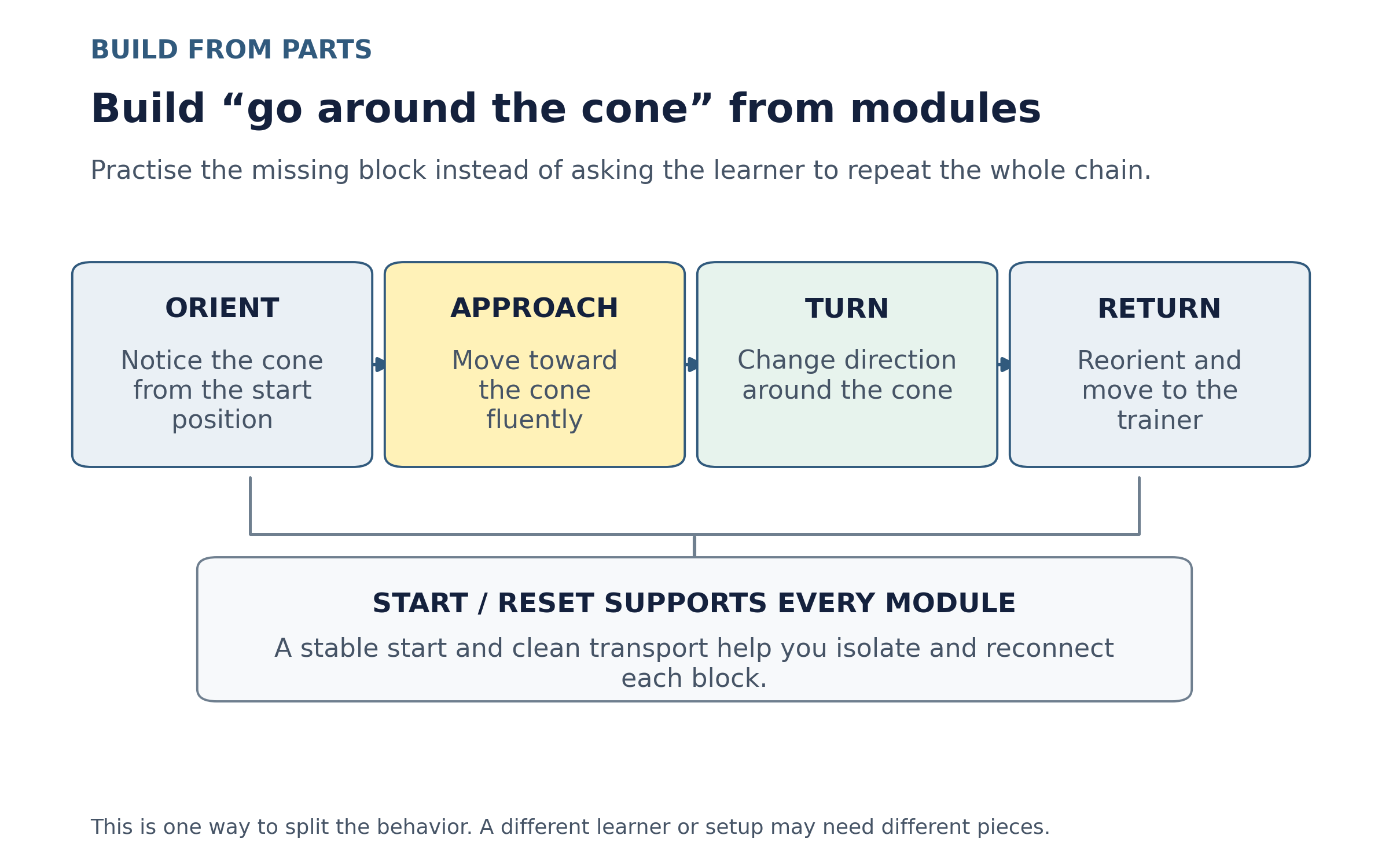
We can teach each part separately, bring the useful pieces to fluency, and then assemble them into one behavior. When something goes wrong, we look for the missing block—not for a learner who is stubborn, confused on purpose, or unwilling to try.
Errorless does not mean perfect. It means I arrange the session so success is easy to find, I know what I am reinforcing, and I change the plan when the behavior tells me something is missing.
“The point is not to prevent every error. The point is to notice sooner, blame less, and know where to look next.”
The learning system in motion
The next repetition begins before you think it does.
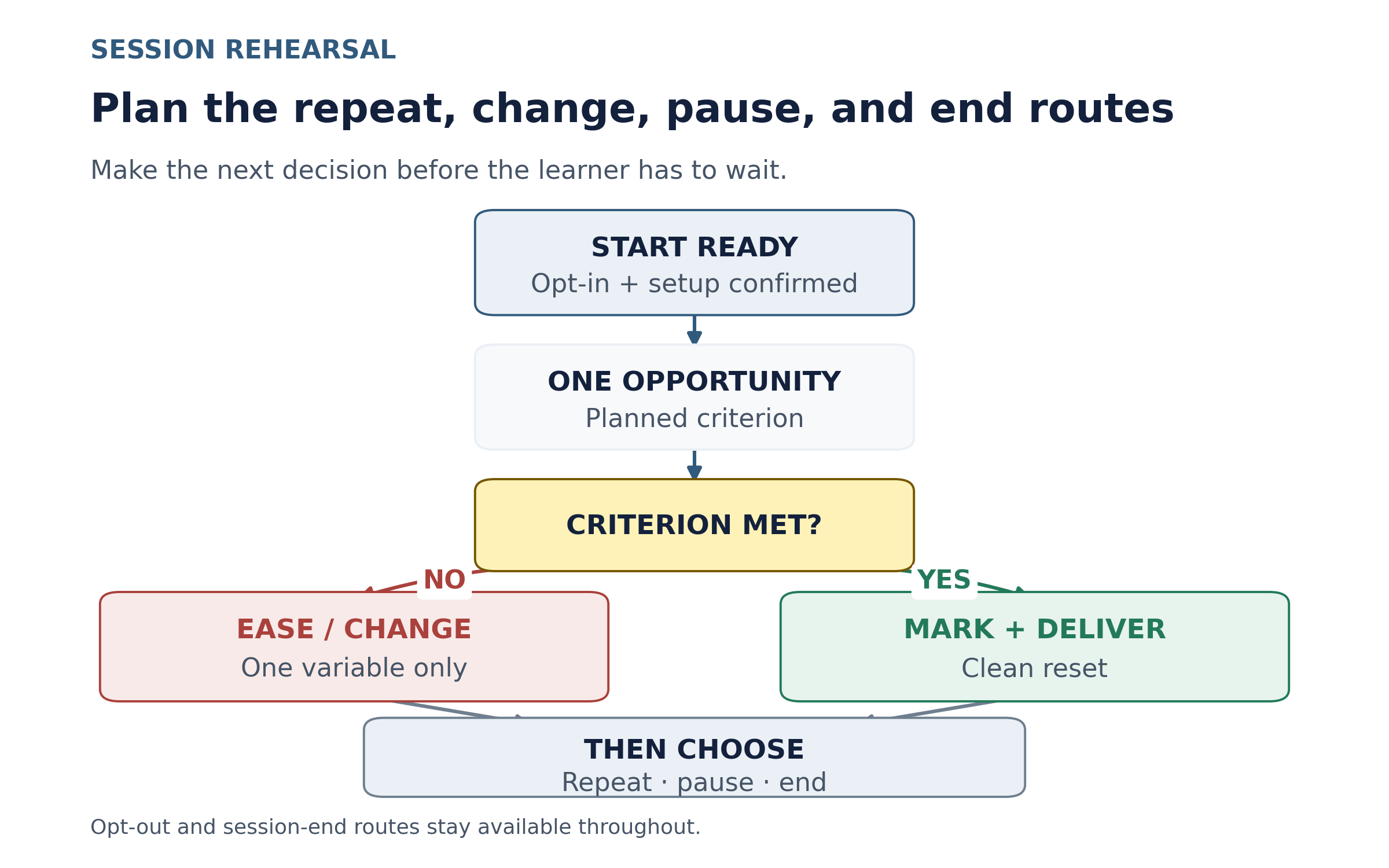
A marker does not end the repetition. How you deliver the consequence, reset, and arrange the next antecedent changes what happens next.
This is why Shape Me Up! does not teach criteria in isolation. We look at the complete loop: latency, movement, marker, delivery, readiness, transport, and the next opportunity. You will learn to see the places where a beautiful plan quietly falls apart.
Join Shape Me Up!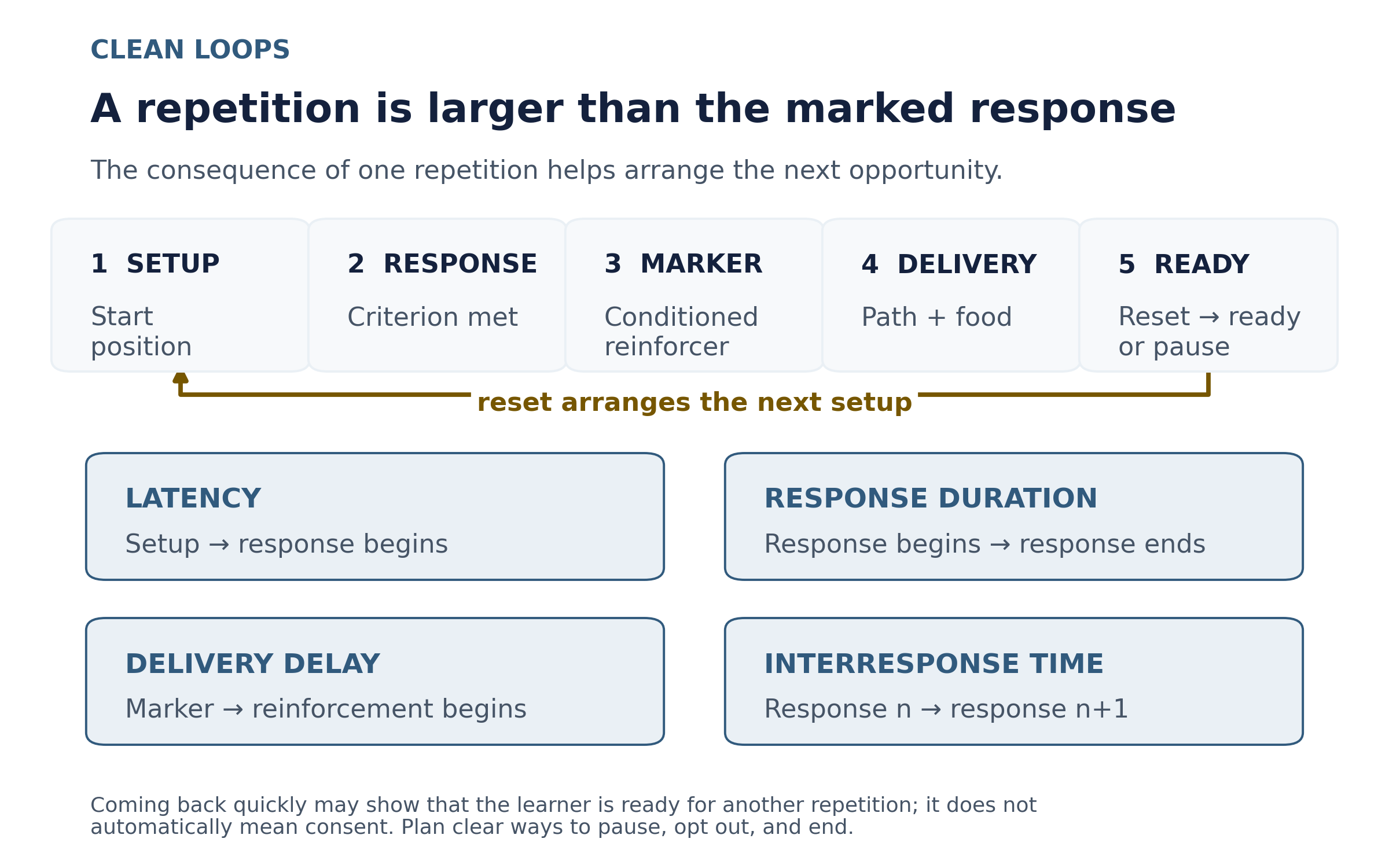
What changes in your training
See the behavior. Build the plan. Teach with clarity.
The course gives you a repeatable way to make decisions. It does not give you one rigid shaping recipe for every learner.
Observe
See the behavior before you explain it.
Plan
Choose the route, criteria, and consequences.
Build
Teach the missing pieces outside the full behavior.
Adjust
Let the learner’s behavior change your plan.
Six weeks, one connected system
What we will work through
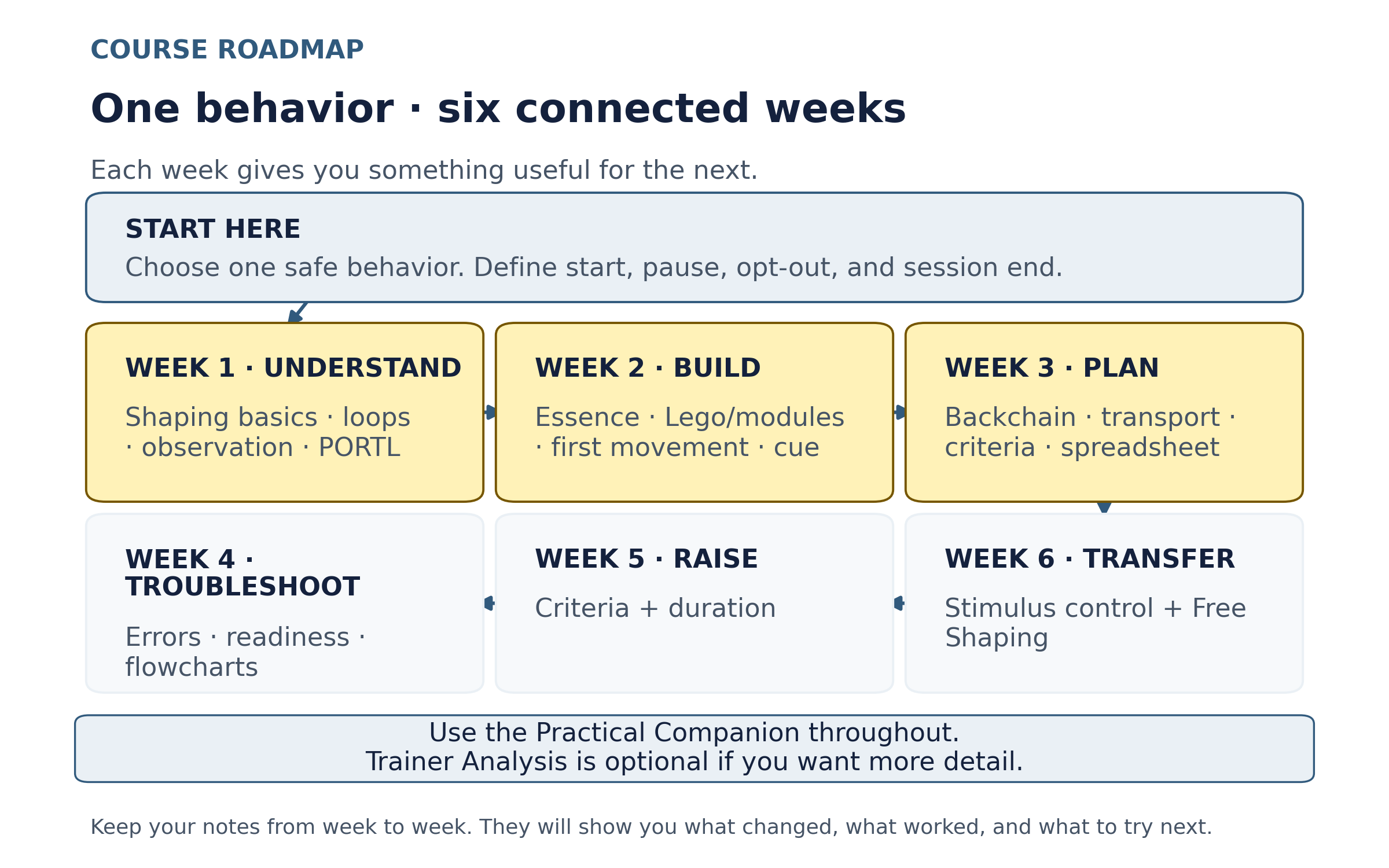
The lessons follow the way a real training plan develops: first you learn to see, then you build, test, adjust, and bring the behavior under reliable control.
Week 1Look before you shape
What shaping is—and what it is not. You will look at the learning loop, separate observation from interpretation, practise with PORTL, and learn to describe the behavior you actually want.
Week 2Build in modules
Leave the imaginary staircase behind. We will work with LEGO-like pieces, choose how to evoke the first useful movement, and test small modules before asking for the whole behavior.
Week 3Write the whole plan
Backchain the teaching plan, arrange transport and reset, write useful criteria, and start using the shaping spreadsheet without turning training into paperwork.
Week 4Find the design problem
When an error appears, do not blame the learner or drop the criterion automatically. Learn where to look: the setup, missing skills, reinforcement delivery, readiness, or the plan itself.
Week 5Change criteria deliberately
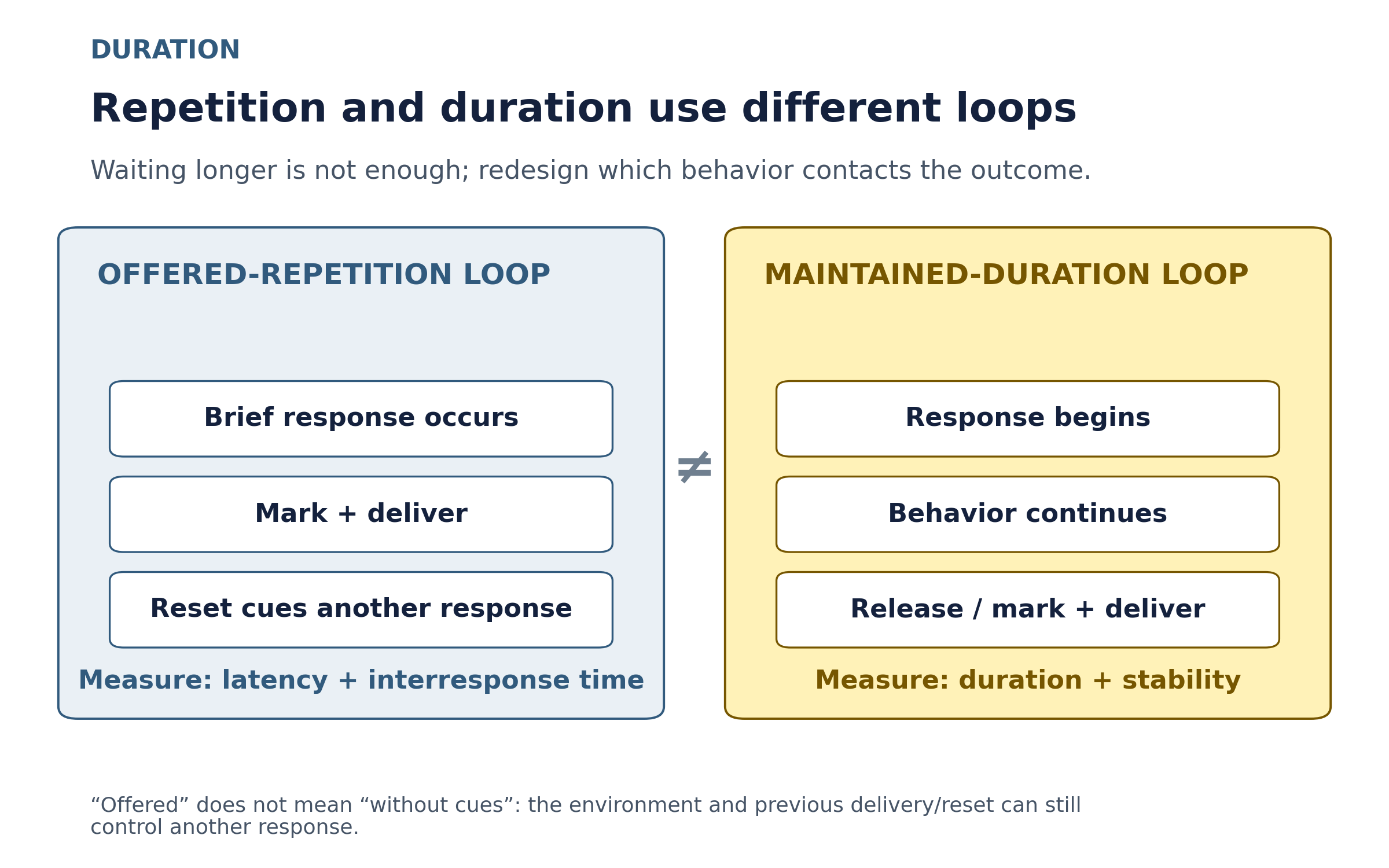
Use small, informed tests instead of rigid repetition rules. You will also work with duration as time—not as distance or number of steps—and learn when the loop itself must change.
Week 6Bring behavior under reliable control
Look at intended and accidental cues, test stimulus control, and connect fluency, maintenance, retention, and generalization. Free shaping remains as an optional place to play with your new eyes.
Course tools you will actually use
You will not be left with theory and a blank page.
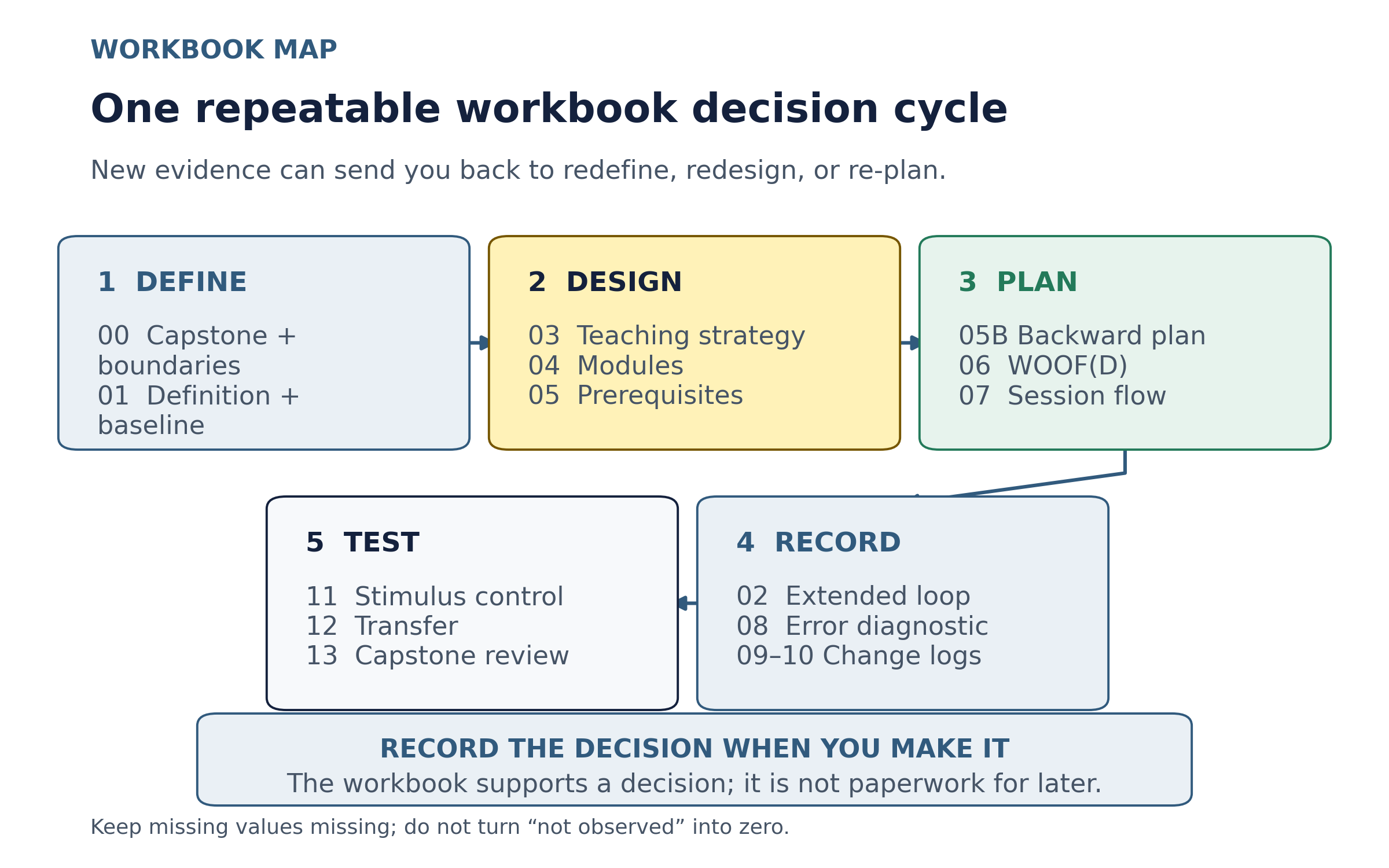
The practical companion keeps the job small: one behavior, five repetitions, one next decision. If you enjoy looking at data, the optional Trainer Analysis workbook lets you go much deeper.
- Two workbook routesA simple practical companion plus optional trainer analysis.
- Real training examplesVideos come with an observation question, not only a play button.
- teaching visualsLoops, module maps, decision paths, flowcharts, and worked graphs.
This course is for you if…
- You want to build behavior without making frustration the plan.
- You need a clearer way to choose and change criteria.
- You enjoy training but sometimes lose the thread between repetitions.
- You want tools that work with dogs and translate across species.
- You are ready to look at your own mechanics as carefully as the learner.
It is not the right edition if…
- You need individual feedback on your own training videos.
- You want one recipe that removes every training decision.
- You expect an “errorless” label to guarantee no mistakes.
- You are looking for a quick trick list rather than a complete system.
This September edition is designed for Auditor / self-study learning.
From previous Shape Me Up! learners
What changed for them
The goal is not only to know more about shaping. It is to see the behavior more clearly and make better decisions while training.
“The most important things I learned are how to describe the behavior I want to teach, analyze it and divide it into small pieces. And this is really the key to shape behaviors. I really learned how to set my dog up for success.”
Arianna Tomassoli
“The content is packed, but after six weeks I can still use the materials for our further work for many months. I recommend it for all dog handlers who want to teach their dogs more consciously and comfortably.”
Janina Gmiter
“The graphics helped me a lot to get a mental picture of what I’m learning about shaping. So much effort has been put behind this course, and I really appreciate it.”
Babak Homayouni
Continue the analysis
Go deeper into the shaping system
These guides examine four questions that often change a training plan: whether errors are required, what to check when a session stalls, how component skills change what we build next, and why familiar behaviors sometimes reappear.
Do dogs need to make mistakes to learn?
A careful look at errorless-learning research, extinction, frustration-related behavior, and what the current evidence does – and does not – show.
Read the errorless-learning evidenceDog shaping stuck? Five things to check
Before lowering the criterion again, inspect food, reinforcement delivery, trainer mechanics, component skills, and the complete session plan.
Troubleshoot a stalled shaping sessionBuild behavior through component skills
Move beyond the staircase model: identify useful behavioral blocks, teach missing pieces separately, and plan how the parts will connect.
Explore modular shaping and component skillsWhy does my dog offer every familiar behavior?
Trace the reinforcement history, identify what changed in the current contingency, and redesign the setup before labeling the learner.
Analyze familiar behaviors during shapingTaught by Agnieszka Janarek
I want you to leave with better questions, not more rules.
I am a behavior consultant, animal trainer, educator, and the founder of Tromplo. For more than a decade, my work has lived in the space between learning science and the decisions we make in a real training session.
Shape Me Up! is not a course about standing back and hoping. It is about learning to observe more precisely, arrange the environment more thoughtfully, and build behavior one useful piece at a time. I will show you my process, including the places where I would stop, change the plan, or teach something else first.
Enrollment for the September 2026 edition
Shape Me Up! — Errorless Shaping
Six weeks of written lessons, video demonstrations, practical exercises, teaching visuals, and two workbook routes.
Before you enroll
Questions worth answering clearly
One clear self-study edition: $139, one year of access, and no individual feedback.
Does this edition include personal feedback?
No. This edition is Auditor / self-study only. There is no individual video review or instructor feedback. You receive the full written course, videos, diagrams, practical exercises, and workbooks to use at your own pace during your one-year access.
Do I need to be an experienced trainer?
No. The practical route starts with observation and one small behavior. Experienced trainers can go deeper through the optional analysis tools and Trainer Geek material, but you do not need an academic background to follow the course.
Does “errorless” mean my learner can never make a mistake?
No. That would be an impossible promise. In Shape Me Up!, errorless shaping is an error-minimizing design goal: we arrange useful success, notice problems early, and redesign instead of relying on repeated failure as the teaching method.
Can I use the course with animals other than dogs?
Yes. Most examples are dog-training examples, but the course is built around observable behavior, antecedents, consequences, criteria, and learning loops. Trainers of other species can translate those principles to their own learners.
How long can I access the lessons?
You have one year of access from purchase. The September edition begins September 1, 2026, and you can revisit the material throughout your access period.
Learning should not feel like guessing.
Not for the learner. Not for the trainer.
Join Shape Me Up! and build one complete training plan with more clarity from the first setup to reliable stimulus control.
Enroll in Shape Me Up! — $139Starts September 1, 2026.