

Creating Behavior, Not Fixing It: Shaping Through Component Skills
 Agnieszka
Janarek
Agnieszka
Janarek
A companion article to my Cog-Dog Radio conversation with Sarah Stremming. Listen to Creating Behavior, Not Fixing It.
Many training questions begin with the word “fix.”
How do I fix a crooked heel position? How do I fix a dog who stops offering behavior? How do I fix the extra step after the click? How do I fix frustration in shaping?
The word is understandable. We see a result we do not want, so we look for a correction. But it can pull our attention toward suppressing the visible problem instead of building the skills that would make a different response possible.
I am much more interested in creating behavior.
That does not mean pretending the problem is not there. It means describing what is happening, deciding what we want the learner to acquire, and constructing the conditions and component skills that support it. The question changes from “How do I stop this?” to “What needs to exist for the useful behavior to occur?”
That is a very different training project. It is what I mean by shaping through component skills.
Shaping is not waiting for a complete answer
Shaping is the differential reinforcement of successive approximations toward a terminal behavior. The learner does not have to produce the finished response at once. We identify achievable versions of the behavior, reinforce them, and change the criterion as the behavior develops.
This definition is simple. Applying it well is not.
“Free shaping” is sometimes used as a valuable exploratory game. It can create space for offering, observation, and play. But when our goal is a specific behavior, reinforcing any interaction with an object and waiting for the learner to discover the final answer is not a sufficient plan.
If I want a dog to go around a cone, looking at it, pawing it, nose-targeting it, and walking toward it are not interchangeable approximations. Some responses may contribute to the terminal behavior. Others may build a strong history for stopping at and interacting directly with the cone. The fact that all of them happen near the object does not make them functionally equivalent.
Shaping requires variation, but variation is not the same as ambiguity. My job is not to remove every possible response. It is to know what I am building and arrange conditions in which a useful next response is likely.
From staircase to LEGO structure
The conventional picture of shaping is a staircase. We reinforce one step, then raise the criterion to the next, then continue upward until the final behavior appears.
Linear shaping can be useful, especially within a small movement. But complex behavior rarely behaves like a neat staircase. It has several parts. Those parts may depend on different movement patterns, positions, props, cues, and reinforcement histories. If one is absent, making the current step smaller may not solve the problem.
This is why I prefer the image of LEGO.
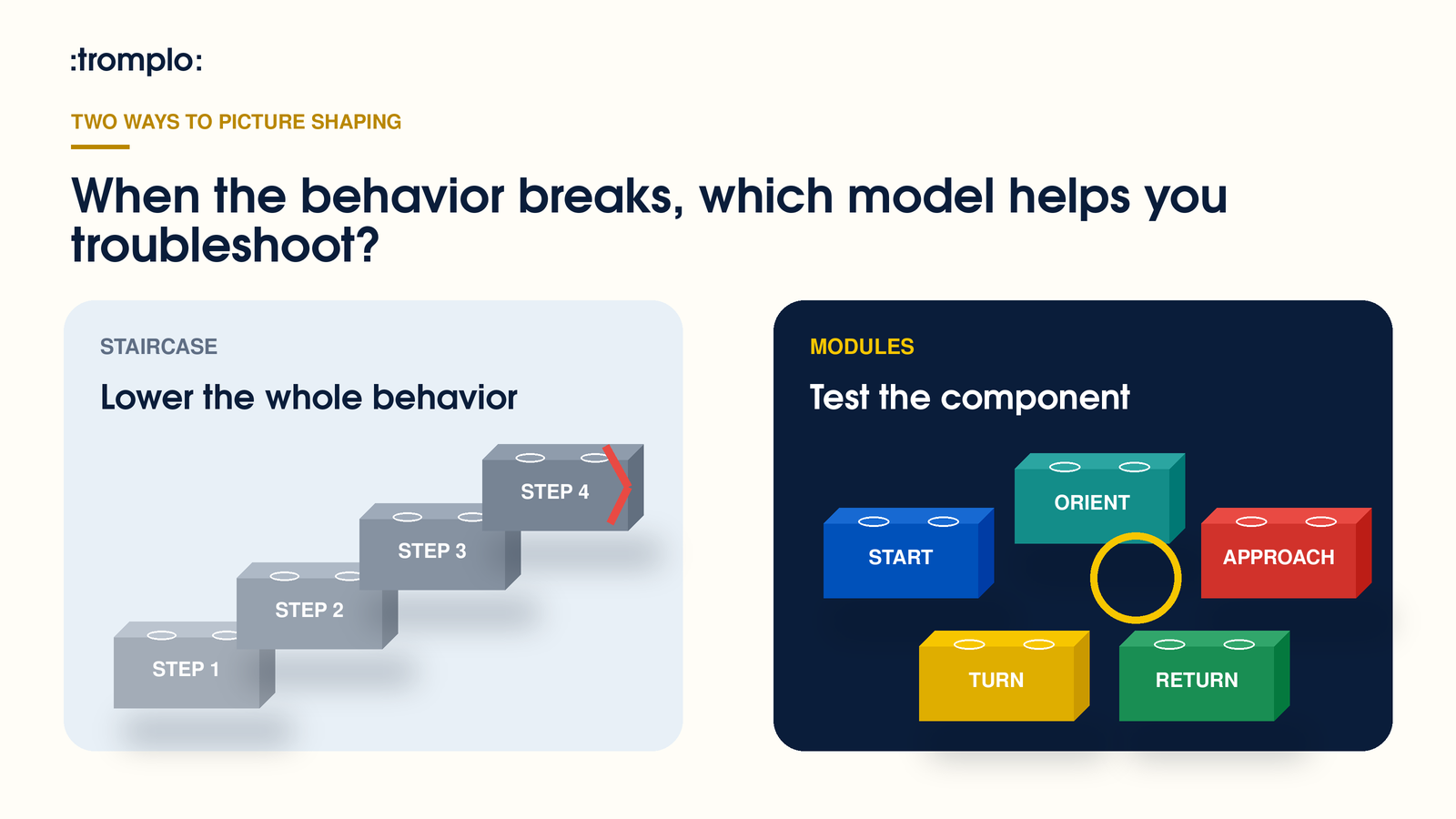
A complex behavior can be treated as a structure made from separate behavioral components. We identify the pieces, teach and test them independently, bring them to useful fluency under the conditions in which we will need them, and then assemble them. The overall process is modular rather than purely linear.
Consider a clean heel-position setup. The final response may include:
- approaching the handler from a particular direction;
- orienting to the handler;
- pivoting the rear end;
- backing or side-stepping;
- maintaining balance;
- a tuck sit;
- a stable head position; and
- standing or sitting still in the final position.
Those are not merely smaller and smaller versions of one response. They are skills with their own movement requirements. I can teach a tuck sit away from heel position, shape pivoting on a disc, develop backing as a separate rear-end-awareness skill, and work on balance without asking for the entire sequence. Later I can combine the reliable pieces, often using a chaining strategy.
When the complete behavior breaks, I no longer have only one option: lower the criterion for the whole chain. I can ask which block is missing or weak.
A missing component can look like a motivation problem
Suppose a dog repeatedly makes an extra side-step while lifting one rear paw toward a target. It would be easy to describe the repetition as sloppy, distracted, or insufficiently motivated. But the side-step may be the only way the dog can keep balance while attempting the movement.
If the learner cannot stand with the rear feet far enough apart, or cannot transfer weight while keeping the rest of the body stable, asking for a more precise paw lift does not make the relevant balance skill appear. Smaller paw-lift criteria may produce a temporary improvement, but the same pattern is likely to return when we ask for more.
The training question becomes: can I teach the balanced stand separately? Can I change the targets so the useful foot position is easier? Can I strengthen the weight shift before returning to the final context?
This is the practical value of component analysis. It replaces a character explanation with a teachable question.
Not every error means a prerequisite is missing. The environment may be different. My body position may have changed. A prop may be unstable. Reinforcement delivery may be cueing another movement. The learner may be tired, uncomfortable, or unable to perform the response safely. Component skills are one part of the analysis, not a universal explanation.
But they are a part trainers often overlook because the final behavior looks like one thing to us.
What makes a useful component?
A module is not an arbitrary fragment. It should help the learner perform the terminal behavior.
When I extract components, I look at:
- the movement patterns required;
- changes in weight and balance;
- direction and pace;
- the starting and finishing positions;
- which body parts move and which remain stable;
- interaction with objects or targets;
- distance from the handler or prop;
- environmental conditions; and
- the cues that will eventually connect the pieces.
Then I ask whether the learner can already perform each component, and under what conditions. A dog may back fluently in front of the handler but not in heel position. A nose target may be reliable at arm’s length but not when the target is low or moving. A station behavior may exist at home but disappear in a new training space. Saying the learner “knows” a skill does not tell us whether it is available in the arrangement we have created.
Useful fluency is contextual. I want enough precision and efficient performance for this component to do its job in the larger structure. I do not need to polish every block into a separate competition exercise before combining anything. I need to know that the piece is stable enough that assembling it will not ask the learner to solve several unknowns at once.
Building the first movement is part of the design
Once we know the component we need, we still have to make the first useful response likely.
Waiting is only one option. I can arrange the environment, use reinforcement delivery to influence the learner’s starting position, introduce a target, use a prompt, capture a naturally occurring movement, or begin from another fluent behavior. None of these procedures is morally superior because it appears less involved. The relevant question is what produces a clear, safe, and fadeable route for this learner.
Imagine that I want to teach a high five and the missing component is the paw lift. If the dog already has the remaining parts of the sequence, I can use a paw target to isolate that movement. As the lift becomes reliable, I can transition from the target to my palm. I am not asking the learner to invent the entire high five. I am shaping the part that is actually missing and using existing skills to support it.
The same logic can apply to harness training. A fluent chin rest and a familiar movement through a large opening can become modules. The harness can be introduced into that known arrangement gradually. Much of the response sequence remains stable while the antecedent setup changes.
Good shaping is not defined by how little help the trainer appears to provide. It is defined by what the arrangement teaches and how clearly assistance can be changed or faded.
Reinforcement connects the blocks
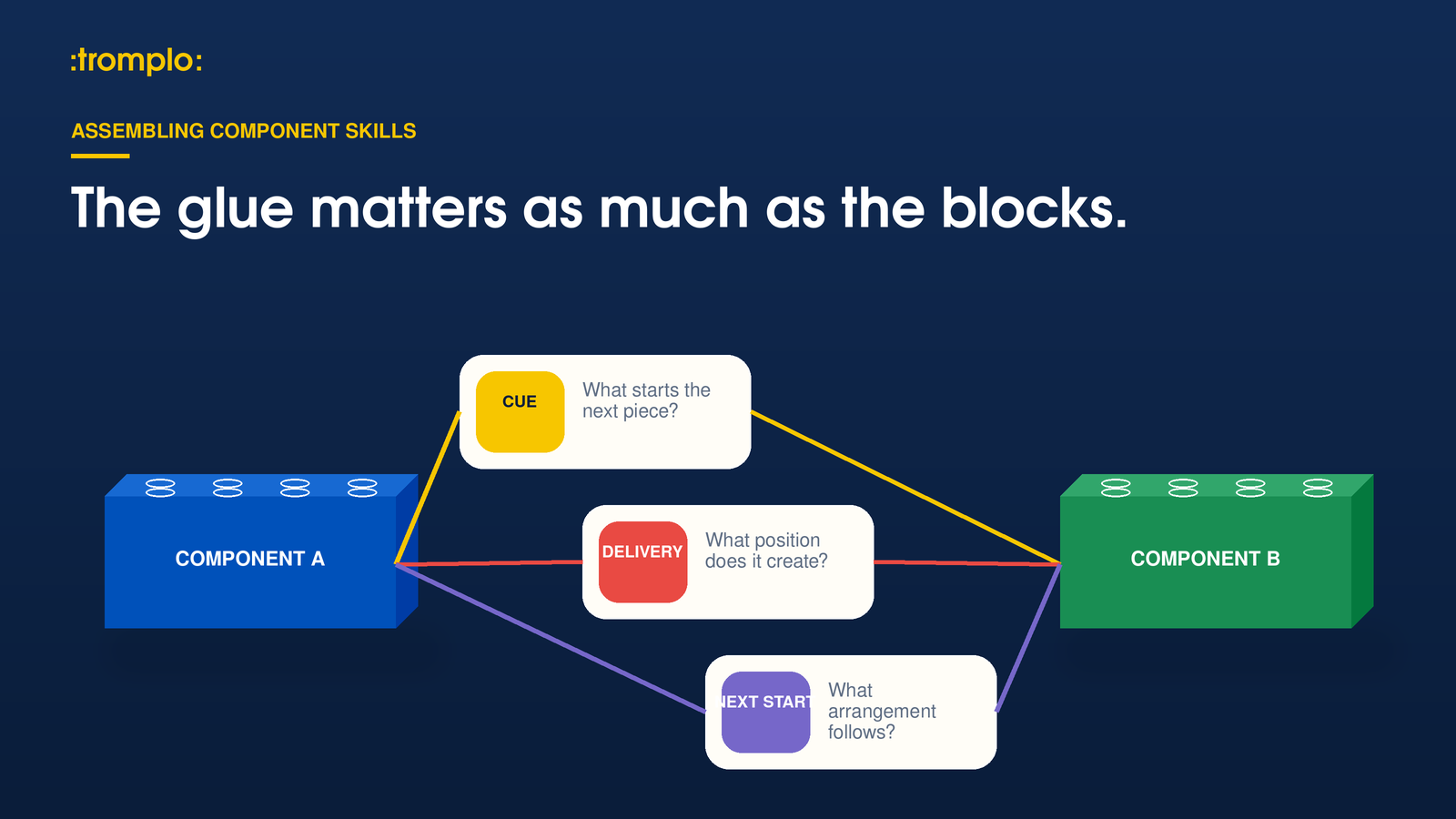
Component training does not end at the marker. Reinforcement delivery influences how one piece connects to the next.
Where the consequence appears can maintain position, evoke a turn, create distance, return the learner to a start point, or accidentally pull the behavior apart. Transport may become part of the chain. The trainer’s hand movement may become a cue. The way the learner consumes food may change the pace and orientation of the next repetition.
This is why a clean individual component can deteriorate when inserted into a larger behavior. The response itself may be fluent, but the transition into or out of it is not.
When assembling modules, inspect the joins:
- What cues the first component?
- What event tells the learner that component is complete?
- Where and how is reinforcement delivered?
- What position does delivery create?
- What cues the next component or the next repetition?
The glue matters as much as the LEGO blocks.
Creating resilience is also a skills project
The companion podcast conversation also touches frustration and resilience because shaping is often defended as a way to make learners “work through” not getting reinforced.
I do not think repeated failure automatically teaches resilience.
If I want persistence, tolerance of a brief delay, returning after an interruption, or trying again after a changed criterion, I need to define the behavior and teach the relevant skills. Those outcomes may develop through carefully arranged variation and challenge. They do not appear simply because I withhold reinforcement until the learner does something different.
Errors will happen. They can be useful information for the trainer. But information for the teacher is not the same as a necessary lesson for the learner. If the same unsuccessful response repeats, I want to ask what the arrangement is producing and what capability is missing.
Do dogs need to make mistakes to learn? looks more closely at the distinction between errors, extinction, frustration-related behavior, and error-minimizing teaching.
Core skills can travel beyond one trick
The most interesting components are not always the spectacular ones.
A learner who can move to a station, follow a clear delivery pattern, return ready for another repetition, interact with a target, hold a stable base position, and use their own behavior to start or pause an activity has tools that can support many future projects.
Those skills do not generalize automatically to every environment. We still have to teach and test them under relevant conditions. But when we build a repertoire of useful modules, each new behavior does not have to begin from zero.
This is where shaping becomes more than producing a trick. We are building learning skills: noticing contingencies, offering relevant behavior, moving between repetitions, using familiar targets and positions, and contacting clear outcomes. The terminal behavior matters, but so does what the learner can do afterward.
A practical way to begin
Choose one behavior you want to teach and work through this sequence before training it again.
1. Describe the terminal behavior
Write what a camera should record. Include the starting position, movement, relevant body parts, location, direction, and finishing position. Avoid labels such as confidently, nicely, or correctly unless you define what they look like.
2. Extract the components
List the movement patterns, base positions, balance requirements, object interactions, delivery skills, and transitions contained in the final behavior.
3. Assess what is already available
Test each important component in a simpler arrangement. Do not rely on “my dog knows it.” Observe its latency, precision, pace, and stability under the conditions you need.
4. Choose one missing block
Build the component separately. Arrange the first useful movement rather than waiting for a large leap. Change one defined variable at a time so you can interpret what happens.
5. Plan the joins
Decide how reinforcement will be delivered, how the learner will move into the next component, and what cues will connect the chain.
6. Assemble and observe
Combine only enough pieces to learn something. If the behavior changes, look at the transition, setup, and component fluency before asking for more repetitions.
This is still shaping. It is simply shaping with architecture.
Create behavior one useful piece at a time
The alternative to “fixing” is not ignoring unwanted outcomes. It is becoming more specific about what we want to build and more responsible for the conditions under which learning occurs.
Related reading: If a shaping session has stopped progressing, check these five parts of the complete training system before lowering criteria again.
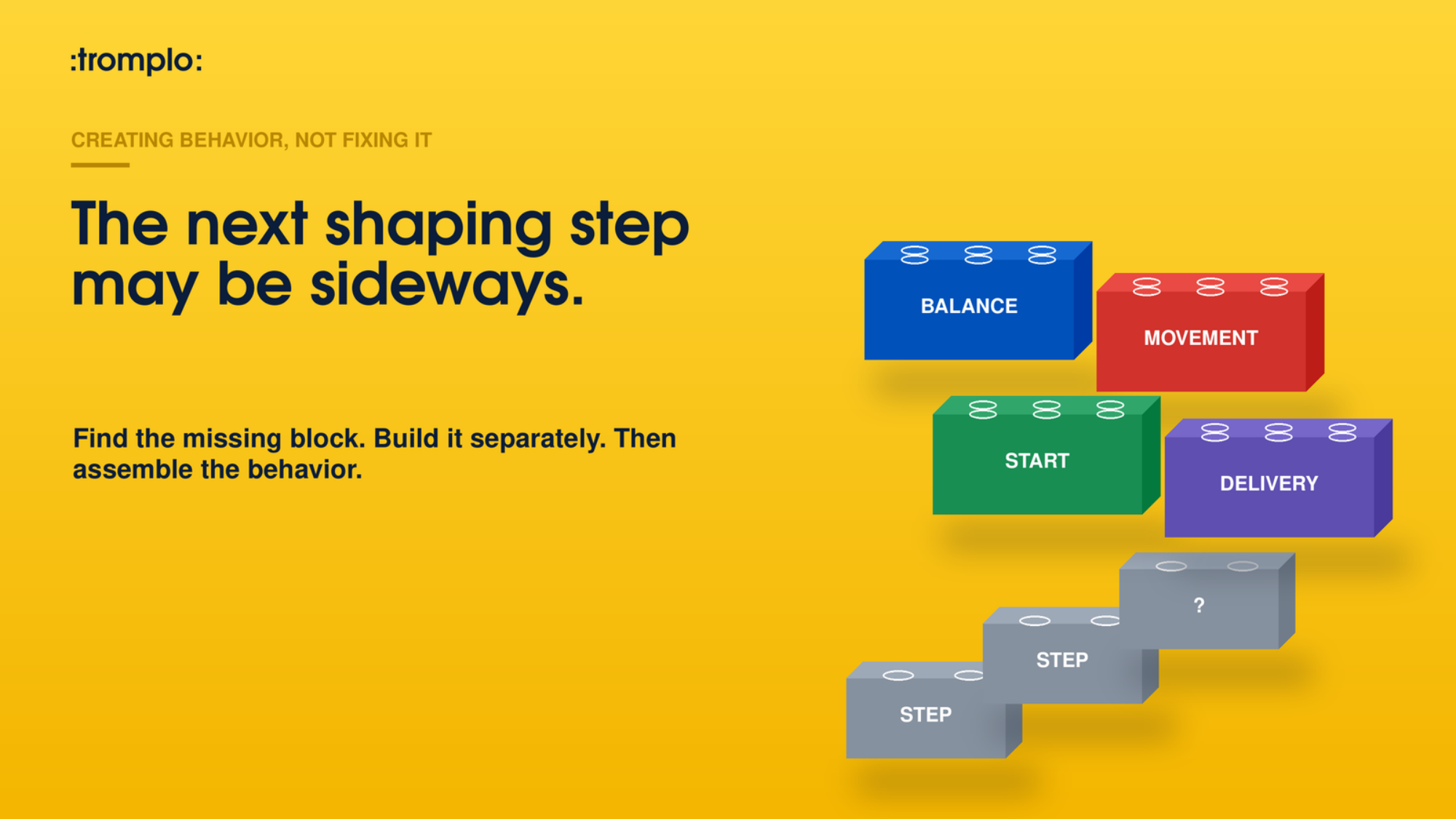
Sometimes the next useful approximation is smaller. Sometimes it is sideways: a component taught in another context, a better start position, a target, a balance skill, or a delivery pattern rehearsed without the learner.
Learning is not a staircase we can force the learner to climb. It is a structure we build together.
If you want to work through the complete process, Shape Me Up! – Errorless Shaping teaches my system for observation, operationalization, modular shaping, criteria, reinforcement delivery, error analysis, duration, and stimulus control.
See also other posts:
August 4, 2026

Why Your Dog Starts Offering Every Familiar Behavior During Shaping
Your dog sits, paws, spins, lies down, and offers every familiar behavior during shaping. Trace reinforcement history and the changed contingency before labeling the learner.
June 30, 2023

Get Your Lost Dog Back Home Quickly: Follow These 12 Tips for Success
Vacations favor more frequent and longer walks with our furry friends. We travel, visit new places. Summer makes us loosen our brakes and allow our…
June 30, 2023

Managing Aggressive Dog Behavior: Tips for Peaceful Living
Living with an aggressive dog may seem challenging, but it can be peaceful and manageable with the right approach. One key aspect is to remain…