

Why Your Dog Starts Offering Every Familiar Behavior During Shaping
 Agnieszka
Janarek
Agnieszka
Janarek
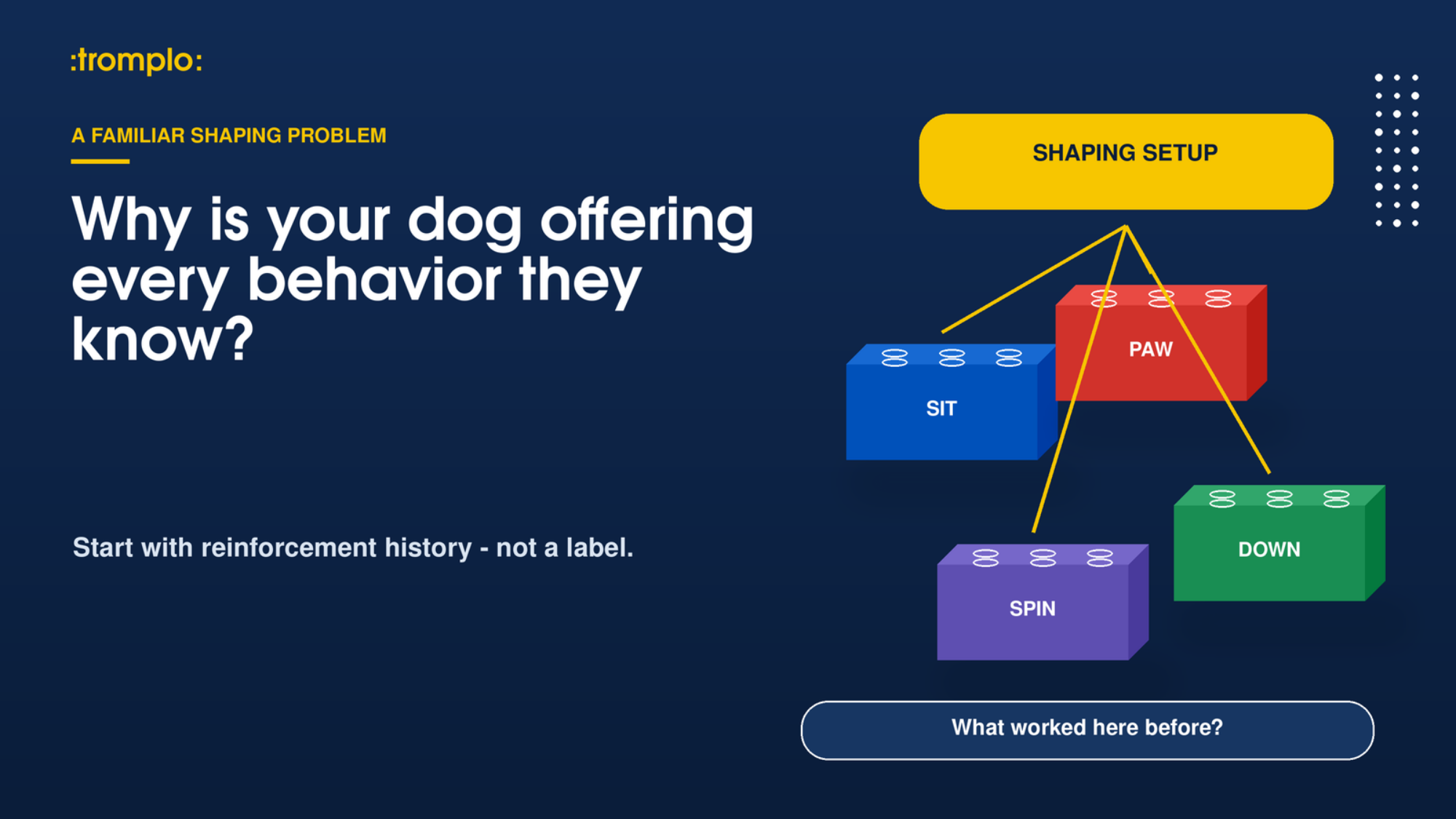
You have built a fluent nose touch to a target in a tight offered loop: touch, marker, food, repeat. Today you decide that you want a slightly longer contact, so the brief touch no longer produces the marker. The dog touches again, taps the target with a paw, sits, lies down, spins, and perhaps barks. Within a few seconds, the session contains nearly every familiar behavior in the dog’s repertoire.
This is often described as the dog “throwing behaviors,” becoming impatient, or refusing to think. I do not find those labels useful. They tell me very little about what happened in the training arrangement, and they make an orderly learning history sound random.
A familiar response often has a history of producing food, access, movement, attention, or another outcome in some context. When the current route to reinforcement becomes unclear, changes abruptly, or is no longer available, responses from an earlier reinforcement history may become visible again.
That does not mean every sit, paw lift, or spin is automatically resurgence. It means the sequence is worth analyzing before we ask the dog to “try harder.”
When your dog offers every behavior during shaping, begin with three questions: which response had been working, what changed, and what had worked in this setup before?
The behavior is not random just because it is not in your plan
Imagine that the first criterion in a session is a brief nose touch to a target. The dog touches, and that response produces a marker followed by food. After several repetitions, you decide that brief contact is no longer enough. You wait for a longer touch, but nothing else in the arrangement changes. You are still standing in the same place, holding the same target, and using the same delivery pattern.
From the trainer’s perspective, the goal has changed. From the learner’s perspective, a response that worked a moment ago has stopped producing the expected marker-and-reinforcement sequence. The new criterion exists in the trainer’s head, but it may not yet be available in the dog’s behavior or clearly supported by the environment.
The dog may repeat the brief touch with a shorter latency or greater force. They may glance between you and the target, move closer, move away, contact it with a paw, or return to responses that have produced reinforcement in similar training contexts. We can observe and describe each of those changes. We do not have to collapse them into “confusion,” “frustration,” or “random behavior.”
Reinforcement history enters the session with the learner
Reinforcement history is not an abstract background variable. Its effects may be reflected in which responses occur, how quickly they occur, and which parts of the environment participate in evoking them. Those patterns help me form hypotheses about the histories worth investigating; they do not let me reconstruct the past from topography alone.
If nose-touching objects has often produced reinforcement, a nose touch is a reasonable response in front of a new object. If sitting in front of the trainer has been reinforced hundreds of times, a sit is likely to appear in many training contexts. If pawing, targeting, circling, and lying down were all reinforced during earlier “do something with the object” sessions, the object may participate in a broad antecedent arrangement for all of them.
The dog is not reading the title of today’s training plan. They contact the arrangement we actually provide: the room, prop, trainer position, food location, recent repetitions, end of delivery, and consequences that follow their responses. Our intended cue may be only one small part of that picture.
This is one reason I am careful when I reinforce a broad range of responses in an “offer anything” exercise. That game can have a useful purpose, but the responses I reinforce under similar conditions enter the learner’s history. If some of them appear in a later session, their return is information about training, not a reason to blame the learner.
Resurgence is a useful hypothesis, not a label for every varied response
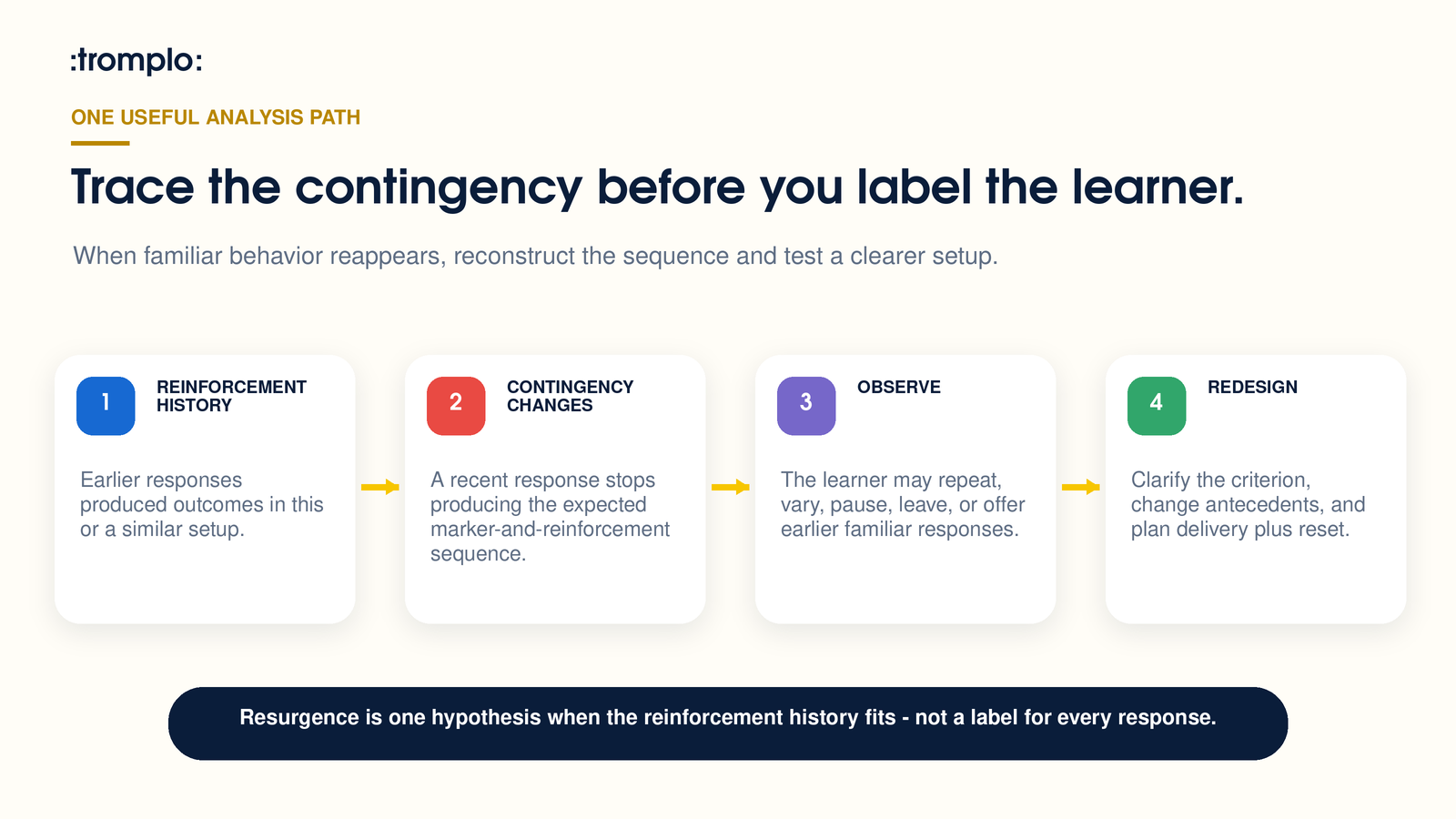
In its stricter behavior-analytic use, resurgence refers to the recurrence of a previously reinforced response after a more recently reinforced alternative stops producing reinforcement. In a shaping session, it may be a useful hypothesis when a current approximation has been producing reinforcement, that relation changes, and earlier reinforced responses reappear.
But topography alone does not establish the process. Seeing a dog sit, paw, or bark does not prove resurgence. One response without a marker is also not enough to conclude that extinction is operating as a meaningful part of the session. I would first want to know whether that response was reinforced before, whether a more recent alternative had been reinforced, what changed in the current contingency, and whether the earlier response appeared after that change.
If I do not know that history, the careful description is simply that a familiar response occurred in this arrangement. That observation is already useful. I do not need to turn it into a diagnosis in order to change the plan.
The same caution applies to frustration. Vocalizing, moving faster, freezing, scratching, sniffing, leaving, or cycling through responses may be relevant to an operational definition of frustration-related behavior, but no single response proves a private emotional state. Context, individual history, and a defined measurement procedure matter. I discuss this evidence boundary in more detail in Do Dogs Need to Make Mistakes to Learn?
Why familiar behaviors may start appearing one after another
The criterion changed, but the environment did not
Trainers often raise criteria silently. We reinforce one approximation several times, decide we now want more, and simply delay the next marker. The dog encounters the same setup but a different consequence for the response that just worked.
A criterion shift does not have to be announced verbally, but it should be supported. I can change reinforcement placement, adjust distance, use a boundary, alter my position, or arrange the object so the next movement is easy to contact. If the only information is a longer period without reinforcement, extinction can begin doing more of the teaching than I intended.
The current approximation is not yet available
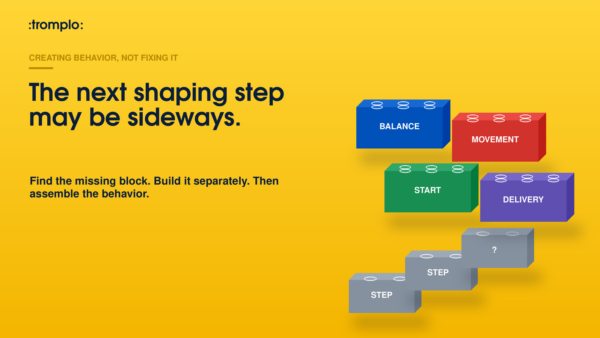
Sometimes the familiar sit or paw touch is simply more available than the movement I am waiting for. Before I assume resurgence, I also ask whether the current approximation requires a component the learner cannot yet perform under these conditions. If it does, waiting longer will not supply it. I can teach that piece in a simpler arrangement and return later. Shaping through component skills develops that modular analysis.
The same training context has cued many responses
A clicker in your hand, food at your waist, a mat on the floor, and your body facing the dog can become a powerful compound arrangement. If many behaviors have been reinforced there without clear discriminative cues, “we are training now” may be more reliable than the specific cue you think you gave.
This pattern can also appear when you begin adding stimulus control. A dog who offers a fluent behavior immediately after reinforcement may continue doing exactly what the previous training loop established. Waiting for a verbal cue is a different behavior in a different contingency; it does not automatically appear because we have decided to add a word.
If the foundations of marker use, criteria, cues, latency, and clean loops are the part you want to strengthen, ABC of Clicker Training provides a structured starting point.
The delivery pattern cues another response
The repetition does not end at the marker. Where reinforcement arrives, how long delivery takes, what the dog does while consuming it, and where both participants finish can set the occasion for what happens next.
If the end of delivery has repeatedly been followed by an offered response, the dog may respond immediately when your hand leaves. If you now want duration or waiting for a cue in exactly the same arrangement, the cues from the old loop may still be present. The problem may not be that the dog “cannot wait.” The current delivery pattern may reliably start the next behavior.
Strategic Reinforcement Delivery for Dog Trainers examines this complete sequence from marker through delivery, consumption, reset, and the next opportunity.
Do not turn the session into a guessing test
Once familiar behaviors begin appearing, two common reactions can make the picture less clear.
The first is waiting longer. Sometimes one brief pause gives the learner space to respond. But waiting is not a neutral teaching strategy when a previously reinforced response has stopped working. If the new approximation is unavailable or the setup does not support it, additional time can produce more repetition, variation, earlier responses, pausing, or leaving. Time does not insert the missing movement into the learner’s repertoire.
The second is clicking one of the familiar behaviors simply to “get the session moving.” That may provide relief for both participants, but it also changes what is being reinforced. If you mark the sit after the nose touch, paw, spin, and down, you may reinforce the final sit. If that pattern repeats, it may establish or strengthen a longer sequence and make the criterion even harder to identify.
This does not mean a trainer must ignore the dog until the correct answer appears. I can pause the exercise, change the setup between trials, return to an easy planned response, or end the session through an established routine. If I use food during that transition, I still need to consider which response it may strengthen. The important point is that I choose what I am teaching instead of letting an unplanned extinction trial make the choice for me.
Redesign the next session before asking for another attempt
1. Describe the sequence, not the dog
Write down what happened in order. What was the last reinforced response? What did you change? How long passed before the next marker? Which response appeared first, and what followed it? What did your hands, feet, shoulders, food, and prop do during that interval?
“The dog became frustrated” gives me fewer training options than “after three reinforced brief target touches, I stopped marking; the dog repeated the touch twice, pawed the target, sat, and then moved away.” The second description shows me where to begin.
2. Identify the relevant reinforcement history
Ask where each familiar response has worked before. Was it reinforced around this object, in this room, in front of this trainer position, or immediately after this delivery pattern? Was it part of a previous shaping sequence? Did one behavior reliably follow another?
You do not need the dog’s complete learning biography. Look for the history most similar to the current arrangement.
3. Make one useful next response available
Define the smallest response that genuinely moves toward the terminal behavior. Then ask whether the dog can currently perform it under these conditions. If not, change the antecedent arrangement or teach a component separately.
For a longer nose target, I might separate duration work from the tight touch-and-reset arrangement, stabilize the target, change my position, and use a delivery pattern that does not immediately cue another brief touch. The goal is not to force the answer. It is to make the useful answer easy to contact and easy to reinforce.
4. Change the antecedent picture when the old one carries too much history
If the same prop and trainer position evoke a large repertoire, make the new task more distinct. Change location, object orientation, distance, your position, a boundary, or the delivery pattern. Build a short reinforcement history for the response you want in that clearer arrangement before returning to the old context.
A setup change is not a trick that guarantees one response. It is a testable adjustment. Observe what changes, keep what helps, and revise what does not.
5. Plan the complete loop
Decide what you will mark, where reinforcement will arrive, what position delivery will create, and how the next opportunity will begin. Also decide what you will do if the criterion is not met. That branch matters. It prevents the dead time in which you wait, search for food, adjust equipment, and accidentally ask the learner to solve a new problem.
If this wider troubleshooting process is useful, Dog Shaping Stuck? Five Things to Check Before Lowering Criteria looks at food, delivery, trainer mechanics, component skills, and the session plan as one system.
A familiar behavior is information about the learner’s history and current arrangement
When a dog offers a sit, paw, down, spin, bark, or another familiar response during shaping, I do not need to treat it as disobedience or proof that the dog is “bad at shaping.” I can ask a more precise set of questions.
- What response had just been producing reinforcement?
- What changed in the contingency?
- Which parts of this setup have cued familiar responses before?
- Is the approximation I want currently available?
- What can I change so the next useful response is clearer?
The pattern may be consistent with resurgence. It may reflect a broad offered-behavior context, a missing component, an abrupt criterion shift, a delivery cue, or several of these at once. The name is less important than tracing the observable relation and testing a better arrangement.
Learning should not feel like guessing. Not for the learner, and not for the trainer.
Build a shaping system that gives you somewhere useful to look
If you want to study this as part of a complete process, Shape Me Up! – Errorless Shaping teaches my system for observing behavior, arranging antecedents, selecting criteria, building component skills, planning reinforcement delivery, and redesigning sessions when the behavior tells us something is missing.
Visit the course page for the current edition and enrollment details.
See also other posts:
August 4, 2026
Creating Behavior, Not Fixing It: Shaping Through Component Skills
Treat complex behavior as a structure: teach useful component skills separately, plan the joins, and assemble them without asking the learner to guess the whole answer.
June 30, 2023
Get Your Lost Dog Back Home Quickly: Follow These 12 Tips for Success
Vacations favor more frequent and longer walks with our furry friends. We travel, visit new places. Summer makes us loosen our brakes and allow our…
June 30, 2023

Managing Aggressive Dog Behavior: Tips for Peaceful Living
Living with an aggressive dog may seem challenging, but it can be peaceful and manageable with the right approach. One key aspect is to remain…